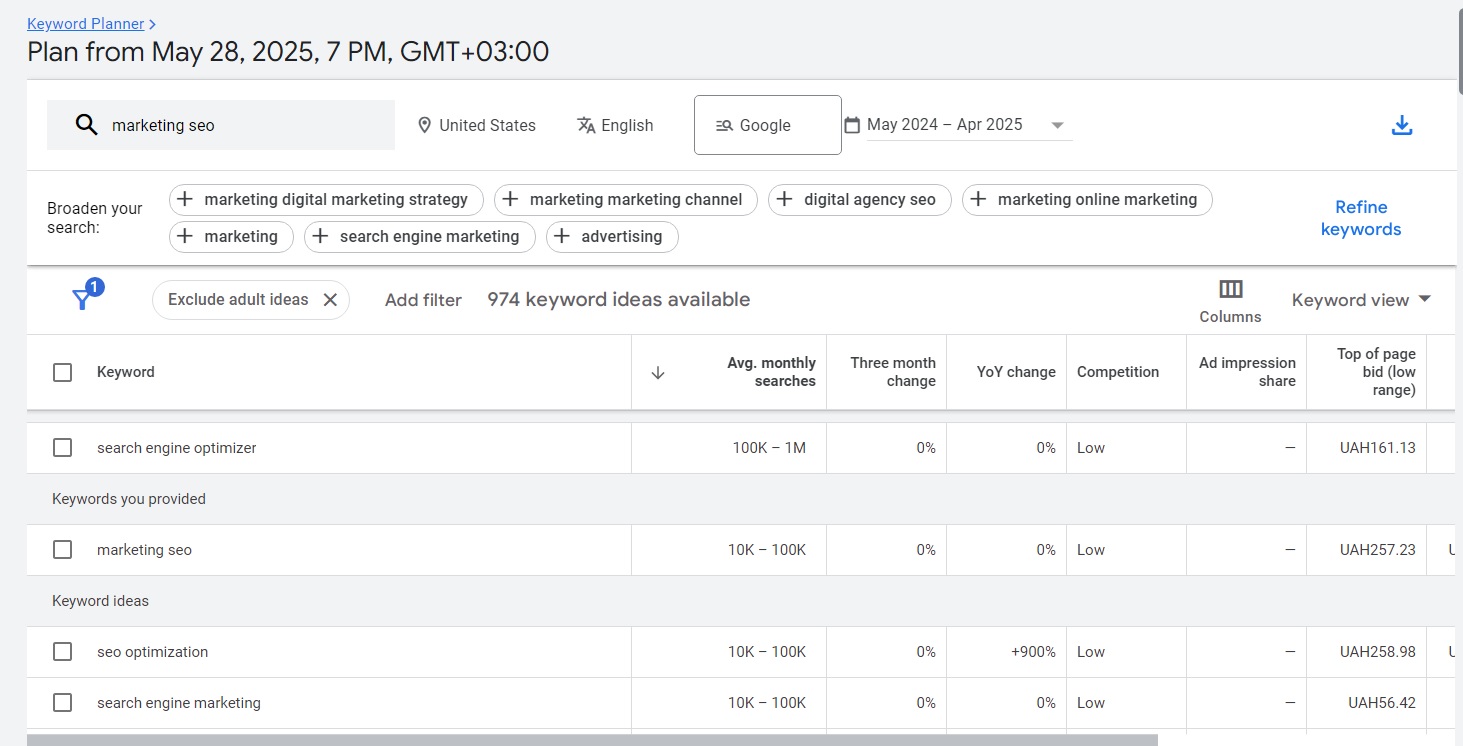
The Right Keywords Change What Content You Need
Targeting the wrong keywords means writing content nobody searches for, no matter how well it's optimized. We research actual search volume, competition level, and real user intent behind each phrase - not just guesses based on what sounds relevant. That research becomes the foundation for every page and article that follows. YOSITE UP!

Selection of popular phrases
SEO KEYWORDS
Professional analysis and selection of SEO keywords suitable for web marketing SEO. We will help you find exactly those keywords that your potential customers are looking for. This is the basis for effective website promotion and increasing search traffic.
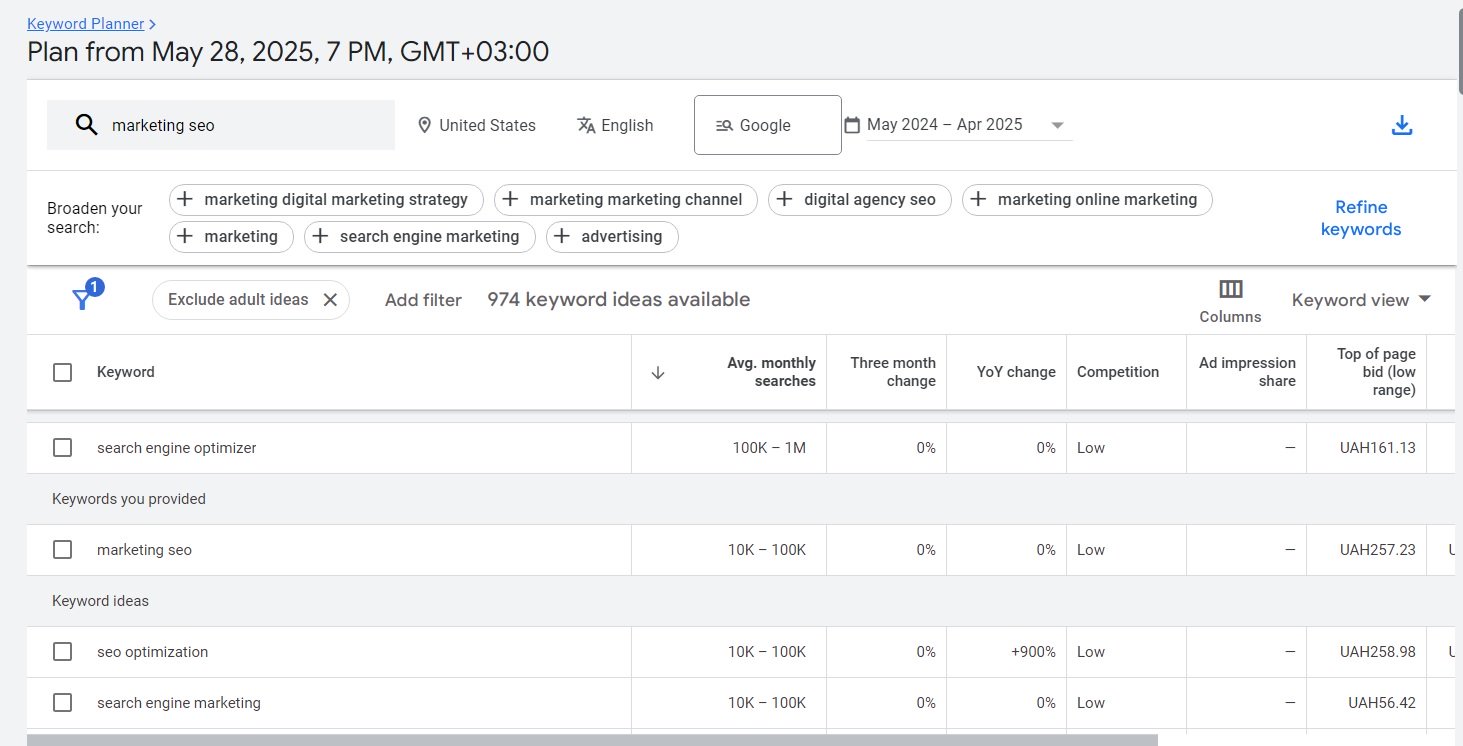
SEO KEYWORDS
Why choose SEO keywords
How SEO keywords help a website
Well-chosen SEO keywords help bring a website to the top of Google, making content more accurate and relevant to user queries. They increase the relevance of pages, improving visibility in searches for the right queries. This leads to growth in organic traffic, customer acquisition and increased conversions without additional advertising costs.
SEO Keywords: What Keyword Research Includes in Your SEO Package
Keyword research is the second stage of the SEO Optimization package after the site audit. It determines which search queries each page of your site will target and forms the semantic foundation for all subsequent content optimization work.
What we do, what tools we use, and what you receive - explained below.
What We Do in the Keyword Research Stage
We work with three data sources: Google Search Console, Google Keyword Planner, and Ahrefs or Semrush. Each provides a different piece of the picture:
Google Search Console shows which queries already bring impressions and clicks to your site - including queries you did not deliberately target. This is the baseline: understanding what Google currently associates with your domain before we add anything.
Google Keyword Planner provides search volume data directly from Google's index. We use it to estimate monthly query volumes and identify semantically related phrases in the same topic cluster.
Ahrefs / Semrush provide keyword difficulty scores, competitor gap analysis, and SERP composition data. We use these to assess which competitors are ranking for target queries and whether their domain authority is realistically beatable for your site.
The process: seed keyword list from your services and pages → competitor gap analysis → semantic clustering → filtering by intent and difficulty → assignment to specific pages.
How We Distribute Keywords Across Your Site
The result is not a flat keyword list - it is a keyword map. Each keyword is assigned to one specific page:
``` /services/ → your main commercial query /services/page-1/ → the primary query for that page /blog/article/ → informational query answered by that content ```
This prevents keyword cannibalization - where two pages on your site compete for the same query and split ranking signals, causing neither to rank well. Each target keyword belongs to exactly one page.
For each page in your site, the keyword map contains:
- Primary keyword - the main search query the page will target
- Secondary keywords - semantic variants and related phrases to include naturally in the content
- Monthly search volume for your target region
- Keyword difficulty score (KD)
- Search intent: commercial, informational, local, navigational
How Package Size Affects Keyword Research Scope
The keyword research process is the same across all packages - the difference is scope:
Package 20 (1-20 pages, $199): Keyword map for up to 20 pages. Typical for service sites and small business websites. We assign 1 primary keyword and 3-5 secondary keywords per page.
Package 50 (20-50 pages, $349): Keyword map for up to 50 pages. Includes category pages and subcategories, with keyword assignments for each.
Package 100 (50-100 pages, $599): Keyword map for up to 100 pages. At this scale, we also identify keyword clusters - groups of related queries that can be addressed by a series of pages rather than one.
Package BIG (100+ pages, $1,199): Full site keyword mapping. Includes semantic structure planning for large catalogues or multi-topic sites.
What We Look at When Assessing a Keyword
We evaluate three factors before including a keyword in your map:
Competition level: If the top 10 results for a query are sites with DR 70-90 (Ahrefs scale) and your site has DR 25, that keyword is not a near-term target regardless of how relevant it is. We filter for queries where your site can realistically compete - typically where competitor pages have DR under 45 and have not been actively updated in the past year.
Search intent match: A keyword must match what your page actually offers. Targeting an informational query ("how does SEO work") with a commercial service page sends a mismatch signal to Google. We assign queries only to pages where the content matches what users expect to find.
SERP composition: Some queries are dominated by Google features - AI Overviews, Featured Snippets, People Also Ask - that reduce organic click-through rates for all ranked pages. We identify these in the keyword map so you know upfront which queries generate less traffic even at top positions.
Common Issues We Find During Keyword Research
No current keywords assigned to pages: Many sites rank for random queries because no deliberate keyword strategy exists. Every page gets traffic by chance, not by design. The keyword map fixes this.
Two pages targeting the same query: A frequent problem on sites that have grown without structure - the blog and the service page both target the same phrase. Google must pick one and often ranks neither consistently. We identify and resolve all cannibalization conflicts.
Targeting only high-volume keywords: Queries with 5,000-10,000 monthly searches are typically occupied by sites with years of domain authority. For most sites in the package range, the most productive targets are 200-1,000 volume queries where competition is accessible. These build ranking history that compounds over time.
Regional mismatch: Targeting queries popular in one country for a site serving another. We use country-filtered volume data - search behavior differs significantly across markets.
What You Receive
At the end of the keyword research stage, before content optimization begins, you receive:
- Keyword map in spreadsheet format - one row per page
- Each row: page URL, primary keyword, secondary keywords (3-5), monthly volume, KD score, intent classification
- Cannibalization conflicts identified and resolved
- Priority notes: which pages have the highest-value keyword opportunities and should be optimized first
This document stays with you and can be used independently from our work - for content planning, PPC campaigns, or future SEO audits.
Frequently Asked Questions
When does keyword research happen in the package timeline? After the SEO site audit (stage 1) and before content optimization (stage 3). The keyword map is the foundation that determines what changes get made in stage 3.
Do I need to provide any input for the keyword research? No input is required. We start from your existing site structure and services. If you have specific queries you want to target - competitors you want to match or geographic areas you want to focus on - we incorporate that. But it is not a prerequisite.
How many keywords will my site have after this stage? One primary keyword per page, three to five secondary keywords per page. A 20-page site will have 20 primary and 60-100 secondary keywords assigned and mapped.
Can keywords be changed after the map is delivered? Yes. The keyword map is a working document, not a fixed contract. If during content optimization we find a better-fitting keyword for a page, we update the map. Changes are reflected in the final work report.
What if my site already ranks for some keywords? Existing rankings are incorporated as the baseline. Pages ranking in positions 11-30 - page 2 and 3 of results - are flagged as priority targets. They are already in Google's ranking consideration and typically need fewer changes to reach page 1 than unranked pages.
What is keyword cannibalization and does it affect my site? Cannibalization is when two or more pages on your site compete for the same primary keyword. Google must choose which page to rank for that query and typically ranks neither consistently. We identify and fix all cannibalization cases as part of the keyword research stage.
Does keyword research cover all languages if my site is multilingual? Each language version requires separate keyword research - search phrasing, volume, and competition differ by market. Multilingual keyword research is included in the package scope if your site has regional language versions.
Last post
From our blog
Local Service Ads Losing Their Google Business Profile Link - A Global Google Ads Incident
AdSense Is Changing How It Counts a Show Worldwide - Here's What February 17, 2027 Means for You