A Report You Can Actually Verify, Not Just Read
A generic monthly summary doesn't tell you whether anything real happened on Google.pl. After SEO work on your site, you get specifics: which errors were found, what was changed, and a fresh audit confirming the fixes actually took effect. Everything checkable against the live site. YOSITE UP!

We will send you a full report
WORK REPORT | Poland
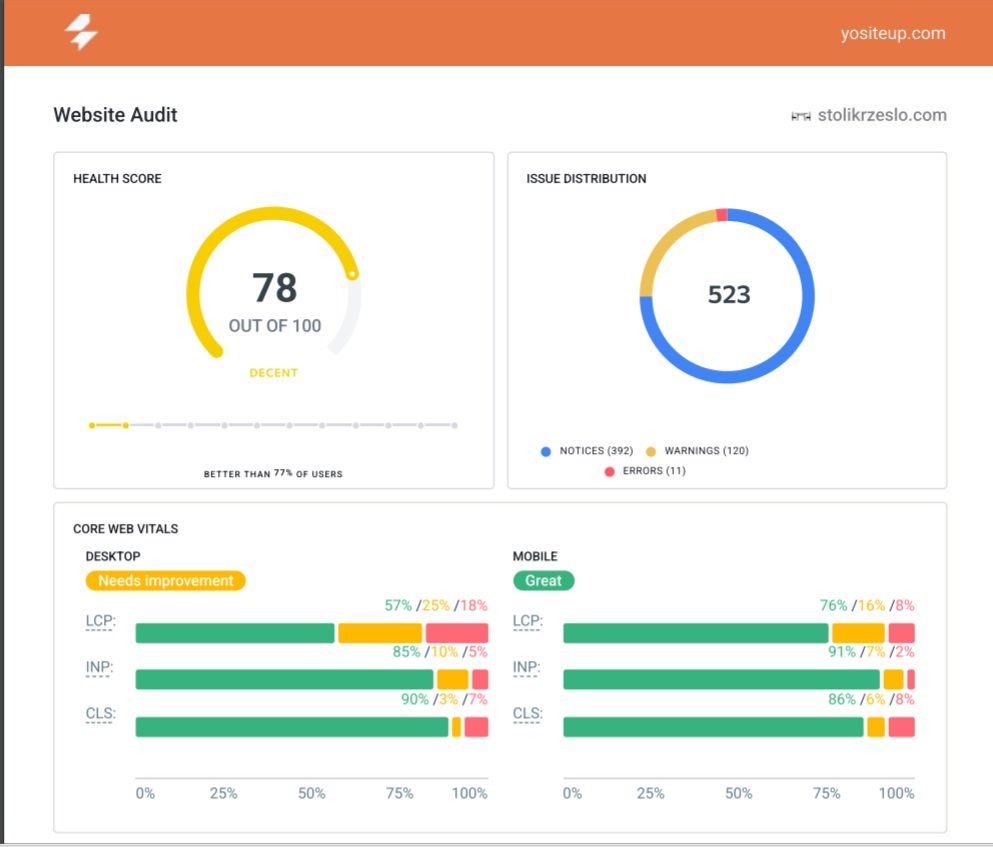
After completing SEO optimisation work, we will prepare and send you a detailed report. The report will include a website audit after the errors have been corrected. It will list all the errors that have been corrected and that affect the website's position in Google. You will receive a transparent picture of the work done and see how the improvements have affected the visibility of the resource.
WORK REPORT
An example of a website SEO audit report. The overall result of the website is shown. The items and pages on which work was carried out are described in detail.
What does SEO audit give
Key phrases and SEO audit
Along with the SEO audit, we will provide a list of key phrases selected specifically for your website pages. These phrases are chosen based on the queries of your target audience and meet Google's requirements for relevance and frequency. This will make your content more search engine friendly and help your website rank higher for the right queries. This is the foundation for further successful SEO promotion.
Get a detailed SEO report on the work done on your project and evaluate the growth in Google PL rankings and traffic from Poland.
Work Report: What You Receive When Your Polish-Market SEO Package Is Complete
The work report is the final deliverable of the SEO Optimization package. It is sent after all five stages are finished - site audit, keyword research, content optimization, fixes, and the closing audit. For Polish-market sites, the report is the same structured document as the standard version but with data and benchmarks specific to Google.pl, Polish search volumes, and the Polish competitive landscape.
Here is what the report contains and how the Polish-market data appears in each section.
What the Work Report Includes
Before and after Health Score comparison
The report opens with your site's Health Score before work began and the Health Score after all corrections were applied. Both are generated using the same audit method - the comparison is direct.
For Polish small business sites (Joomla or WordPress) that start with no deliberate SEO history, the typical starting Health Score is 35-50. After the full package, sites in this range typically finish at 65-75 - above the Polish market average. For Polish PrestaShop stores, starting scores are often lower (25-40) due to default duplicate URL generation; finishing scores typically reach 55-70 depending on the platform version and hosting configuration.
The report explains which specific corrections drove the Health Score improvement - not just the before/after numbers but the causal link between fixes applied and score change.
Page Health Ratio before and after
Alongside the Health Score, the report shows the percentage of your site's pages free of critical and warning-level errors - before the package and after. For Polish e-commerce sites with PrestaShop or Shoper, where filter pages and supplier pages can account for a significant portion of indexed pages, the Page Health Ratio change reflects both direct corrections applied to your pages and the canonical/robots.txt handling applied to automatically generated URL variants.
Keyword map for Google.pl
The keyword map delivered in the work report reflects Polish-market data throughout. Every page in your package includes its assigned primary keyword in its dominant Polish search form (Ukrainian-inflected form for Polish pages, or Polish-market English phrasing for en-PL pages), secondary keyword variants, monthly search volume on Google.pl (sourced from Senuto or Semrush Polish database), and keyword difficulty score calibrated to Polish SERP competition.
Volume figures in the Polish keyword map are lower than equivalent global figures - this is accurate, not a data limitation. A keyword showing 2,000 monthly searches on Google.com may show 150 on Google.pl. The Polish market is smaller, but the conversion rate for locally targeted Polish traffic is typically higher. The report presents these figures as they are, without inflating them against global benchmarks.
The keyword map remains yours after the package is complete. It can be used for:
- Content planning for future Polish-market blog posts or service pages
- PPC targeting on Google Ads (Polish market) using the same search volumes and keyword difficulty scores as a guide
- Briefing a Polish copywriter or content team with specific keyword requirements
- Baseline comparison if you run a follow-on SEO audit 6-12 months later
Full list of corrections made per page
Every change applied during content optimization (stage 3) and fixes (stage 4) is listed by page URL, with before and after values. For Polish sites, this section may include:
- Title tag changes that reflect Polish-market keyword inclusion or correct Polish CMS title inversion patterns
- Meta description rewrites calibrated to Polish search result click behavior
- H1 changes with Polish keyword forms in the appropriate grammatical inflection
- Alt attribute additions in Polish (for Polish-language pages) or in English with Polish-market context (for en-PL pages)
- Canonical tag corrections - including corrections to Polish Joomla template-level canonicals and PrestaShop multi-path canonical handling
- Redirect corrections after Polish hosting migrations
- robots.txt changes where Polish CMS configurations blocked pages unintentionally
You can verify each entry against your live site using your browser's developer tools or a meta tag inspection extension. The before/after format means you do not need SEO knowledge to confirm a change was applied - you can compare the listed value against the current page source directly.
Issues identified but outside package scope
The Polish web landscape often surfaces issues that require work beyond the package scope - most commonly:
- Polish hosting-tier speed issues (slow TTFB on shared home.pl or nazwa.pl plans) that require hosting upgrade or CDN implementation rather than on-site code changes
- PrestaShop or Shoper platform architecture issues that generate URL duplication at a structural level, requiring development work to resolve at the source
- Pages outside the package page count with errors that were identified in the audit but not corrected
- Content thinness on Polish-language blog posts or category pages that would require new Polish content to resolve
Each item in this section includes the error type, affected pages, and a specific recommendation. If the recommendation requires a Polish-speaking developer or copywriter, we note that.
Google.pl ranking positions for target keywords
For sites with 3+ months of Google Search Console history filtered to Poland, the work report includes current ranking positions for primary keywords assigned in the keyword map. These are positions on Google.pl - not Google.com - measured from your GSC data at the time of report delivery.
These positions are a baseline snapshot, not the final outcome. Polish sites typically see ranking movement over 4-12 weeks following the package as Google recrawls optimized pages and processes technical corrections. Rankings on Google.pl for Polish-market queries follow the same recrawl cycle as other markets - Googlebot crawls Polish sites with the same frequency as equivalent international sites.
Timelines for Polish-Market Packages
Package 20 ($199): 10-15 business days from the point CMS access is confirmed, to work report delivery. For Polish small business sites (homepage, service pages, contact, about), this timeline is consistent.
Package 50 ($349): 15-20 business days. Includes Polish blog post optimization and PrestaShop/Shoper category-level work.
Package 100 ($599): 20-30 business days. At this scale, template-level corrections for Polish Joomla or PrestaShop sites add processing time - a single template correction may resolve errors across 20-30 pages simultaneously, which requires careful pre-implementation testing.
Package BIG ($1,199): 30-45 business days depending on site complexity. Polish e-commerce sites at this scale require systematic canonical correction across category, filter, and product pages - the most time-intensive part of the work.
Timelines assume CMS access is provided promptly. Polish agency-built sites sometimes require the original developer's involvement to provide access - delays at this step extend the timeline proportionally.
What "Decent" Health Score Means for Polish Market Sites
The target of Health Score 60+ (Decent) is the minimum threshold we aim to reach by the end of the package. For the Polish market specifically:
A score of 60-74 ("Decent") places your site above the average for Polish-market small business sites in most categories. Polish competitor sites in service categories (legal, accounting, construction, medical, real estate) typically score 35-55 without active SEO investment. Reaching 60+ means your site has fewer technical barriers to ranking than most of your Polish competitors.
A score of 75+ ("Good") is achievable for Polish sites starting at 40+ that have primarily on-page and redirect issues. Sites with structural platform issues (PrestaShop default URL duplication, hosting-tier speed problems) may reach 65-72 within one package cycle and require a follow-on package or hosting change to push further.
How to Use the Report After Delivery
Verify each correction on your live site: The report gives you specific page URLs and element-level changes. For Polish Joomla sites, you can verify via Joomla's article editor (check the SEO metadata tab). For WordPress, via Yoast or Rank Math fields. For PrestaShop, via the Metadata tab in each product or category.
Share with your Polish developer or web agency: The corrections list is structured to be readable by a Polish web developer without SEO background. If your site was built by a Polish agency and they maintain it, sharing the report gives them the reference point they need for any future changes.
Use the keyword map with Polish content creators: If you work with Polish copywriters or a Polish content marketing team, the keyword map gives them the exact terms, volumes, and priority ordering needed to write content that targets the Google.pl queries your site is positioned for.
Monitor Google.pl positions over the following months: Rankings on Google.pl reflect the recrawl cycle. Check your target keyword positions monthly for the first three months using Google Search Console filtered to Poland. The movement pattern typically shows initial position improvements on long-tail queries within 4-6 weeks, with broader keyword improvements appearing over 8-12 weeks.
Frequently Asked Questions
Can I share the work report with a Polish business partner or investor? Yes. The report format is designed to be readable by non-specialists. The before/after Health Score comparison, the keyword map, and the corrections list are all self-explanatory documents. If your Polish business partner or investor needs context on specific SEO terms, we can add a brief glossary section on request.
The report shows a page still ranks at position 25 on Google.pl. Should I be concerned? Position data in the report is a snapshot taken at delivery. Rankings for newly optimized pages shift over the following weeks. Position 25 at report delivery for a page that was previously unranked means it has entered the Google.pl index and is now being assessed - this is a normal early-stage position that typically improves over 4-8 weeks as Google processes the optimized content.
What if a correction in the report is not visible on my live Polish site? Polish CMS caching plugins (W3 Total Cache, WP Rocket on WordPress; Joomla cache settings) can delay meta tag changes from appearing in the page source. Clear the site cache after the work is complete. If the change is still not visible after cache clearing, contact us with the specific page and element - we will verify whether the change needs to be reapplied or whether a CMS setting is overriding it.
Does the keyword map include data for Senuto-only queries not found in Semrush? The keyword map uses the most accurate volume source available per keyword. For Polish-language long-tail queries, Senuto often provides better data than Semrush or Ahrefs. For higher-volume national queries, Semrush and Ahrefs Polish databases are reliable. We note the source for each keyword set in the map header.
Can I use the work report as a brief for a Polish PPC campaign? Yes - the keyword map is structured to be useful for Google Ads (Polish market) targeting. Primary keywords with volume and difficulty scores map directly to PPC keyword lists. The distinction between high-competition keywords (where organic ranking takes time) and lower-competition keywords (where organic results may appear faster) is useful for deciding where to run PPC alongside organic optimization.
What happens if we publish new Polish-language pages after the package is complete? New pages published after the package is delivered are not covered by the current package. They appear in the "outside scope" section of the work report under "pages not yet indexed at time of work." A follow-on package can cover new pages once they have been indexed and their baseline state established.
Last post
From our blog

What Poland-Based Agencies Need to Know About the Local Service Ads Unlinking Bug
Running AdSense From Poland? Here's What Changes on February 17, 2027