What's Really Holding Back Your Google.pl Rankings
A generic checklist audit misses what's actually wrong on Google.pl. We check crawlability, duplicate content, page speed, structured data, and internal linking specifically against Polish search behaviour, then hand you a prioritized fix list ranked by real impact, not by how easy each item is. YOSITE UP!

General audit of your website
SEO SITE AUDIT | Poland
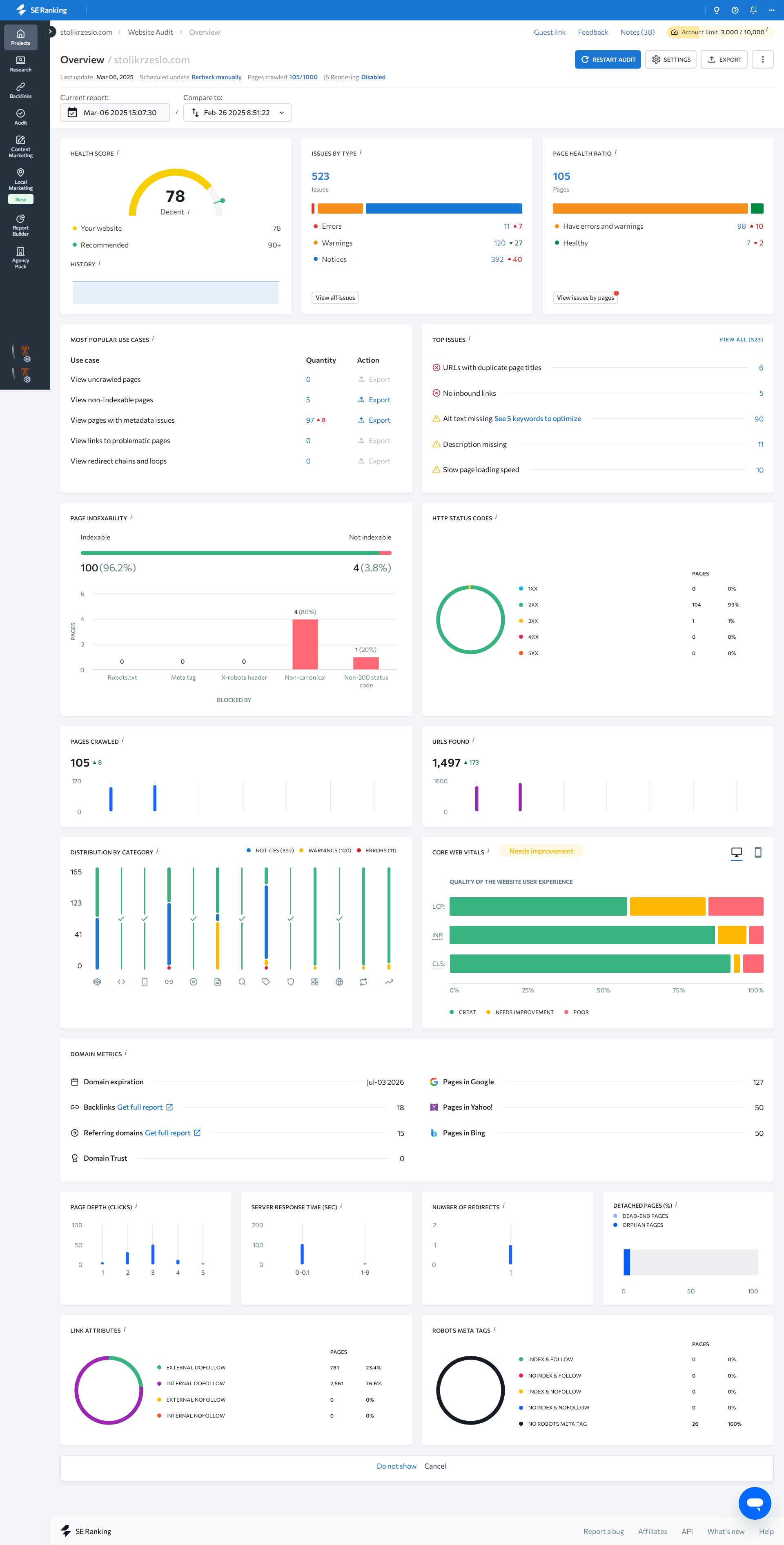
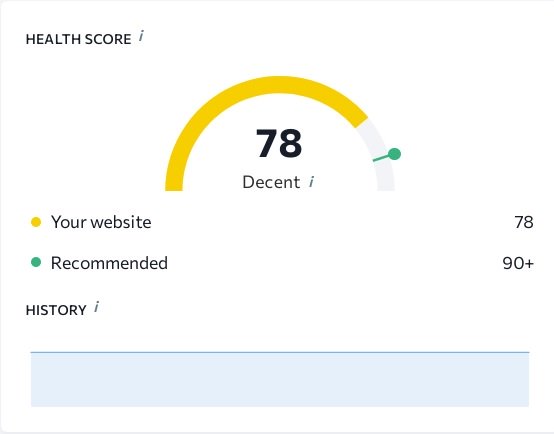
A website audit will reveal the main shortcomings of the website in terms of internal optimisation. Internal optimisation will improve your website's performance in search engine results. We provide a report on the SEO performance of the website's HEALTH SCORE before and after the work is completed.
Why conduct a Google.pl SEO audit for your Polish website
Periodic audits allow you to respond promptly to changes in algorithms, improve the structure of the resource, and create conditions for stable growth in organic traffic. This is an important step in the development strategy of any results-oriented website.
Fixing Google.pl ranking problems for Polish websites
Conducting an SEO audit allows you to identify and eliminate critical errors that hinder effective promotion. Among the most common problems are:
Slow page loading
Problems with content indexing
Duplicate or non-unique content
Incorrect or missing meta tags
Lack of mobile device adaptation
Confusion in the structure and navigation of the site
Correcting these shortcomings significantly increases the chances of the site reaching the top of search results, attracting more visitors and increasing conversion rates.
Order your free SEO audit for the Polish market to understand what errors are preventing your website from growing in Google PL and receiving traffic in locations across Poland.
SEO Site Audit for Polish-Market Sites: What We Check and What You Receive
The SEO site audit is the first stage of your SEO Optimization package. For Polish-market sites, the audit produces the same three core indicators - Health Score, Issues by Type, and Page Health Ratio - but uses data sources and benchmarks calibrated to Google.pl and the Polish web landscape.
Polish sites present patterns of technical issues that differ from Western European or US sites. The CMS ecosystem in Poland skews toward Joomla and PrestaShop alongside WordPress. Polish hosting providers have specific server configurations. Polish e-commerce architecture generates URL structures that require Poland-specific audit methodology. This page explains what the audit covers for your site and how we approach each category.
Three Metrics in the Audit Report
Health Score
A composite score (0-100) reflecting the overall SEO condition of your site. For Polish-market sites, we benchmark the Health Score against Polish-market norms: a Polish Joomla business site with no deliberate SEO work typically scores 35-50. A newly launched Polish WordPress site with default settings scores 40-55 depending on the theme. A PrestaShop store without SEO configuration often scores 25-40 due to the duplicate URL patterns PrestaShop generates by default.
We target a Health Score of "Decent" (60+) as the minimum outcome from the package. Sites that start in the 30-45 range - typical for Polish small business sites - generally reach 65-75 after all five package stages.
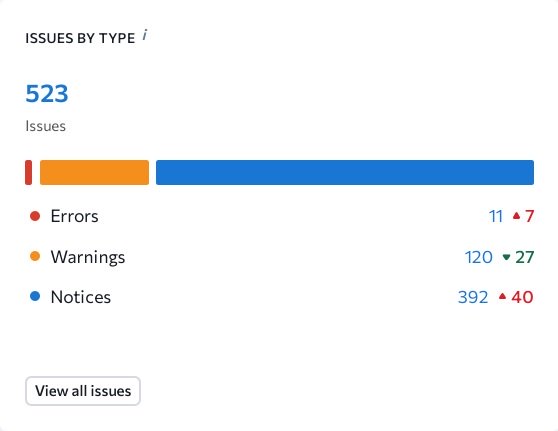
Issues by Type
A complete list of errors grouped by category: technical errors (crawl blocks, redirect issues, server-level problems), on-page errors (missing or duplicate titles, missing H1), content errors (duplicate pages, thin content), and speed issues (Core Web Vitals failures). Each issue shows the number of affected pages and severity level.
For Polish sites, Issues by Type commonly shows a higher-than-average count of duplicate content issues - particularly on PrestaShop and Shoper installations - and a high frequency of robots.txt configuration errors on Joomla sites where SEF URL setup was not completed correctly.
Page Health Ratio
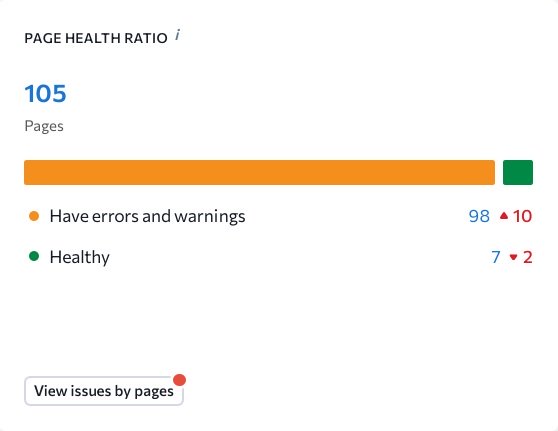
The percentage of your site's pages free of critical and warning-level errors. We measure this before work begins and after all stages are complete. The before/after comparison is how you verify the package outcome independently.
What the Audit Checks for Polish Sites
Google Search Console data for Google.pl
We begin with your Google Search Console data filtered to Poland. GSC shows which of your pages Google has crawled, which are indexed, which are excluded and why - and which Polish queries your pages already appear for. For Polish-market packages, GSC filtered to Poland is more relevant than global GSC data. A page may rank on Google.com but not on Google.pl, or vice versa.
Common GSC findings on Polish sites:
- Pages listed as "Discovered - currently not indexed": common on Polish sites with large numbers of product pages that were added faster than Googlebot could process them. This signals crawl budget allocation issues.
- Pages excluded as "Duplicate, Google chose different canonical than user": frequent on PrestaShop and Shoper installations where canonical tags were not explicitly set
- Pages excluded as "Crawled - currently not indexed": often thin category pages or automatically generated archive pages that Google has crawled but assessed as low-quality for indexation
Technical crawlability for Polish CMS configurations
We verify that Googlebot can access all pages that should be indexed. For Polish sites, this includes checking:
- WordPress (Polish installations): the "Discourage search engines" setting in Settings → Reading, Polylang and WPML configuration for language-specific sitemaps, and Rank Math or Yoast sitemap accuracy
- Joomla (widely used in Poland): the `.htaccess` activation status for SEF URLs, the SEF URL and URL rewriting settings in Global Configuration, and the Joomla redirect component history
- PrestaShop: whether the friendly URL feature is enabled and whether the `.htaccess` file matches the PrestaShop-generated version, supplier/manufacturer/tag pages crawlability status
- Shoper: the platform's built-in sitemap, filter URL crawlability settings, and whether Shoper's canonical tag options have been configured
Indexation status with Polish-specific exclusion patterns
Beyond crawlability, we check which pages are actually in the Google.pl index. For Polish sites, common indexation issues include:
- Polish Joomla sites where SEF URLs were enabled after initial indexation without redirects - causing the original non-SEF URLs to remain indexed alongside the new SEF URLs, creating duplicate indexation
- Polish WordPress sites with Polylang where both the Polish and English versions of pages exist but only one is marked with a canonical, causing the other to be excluded unpredictably
- PrestaShop product pages indexed in multiple category paths due to PrestaShop's multi-category product assignment feature
On-page elements audit for Polish pages
Every page is checked for title tag presence and uniqueness, meta description presence and uniqueness, single H1, heading hierarchy, image alt attributes, and internal link structure. For Polish-language pages, we also note:
- Whether keyword targeting is visible in on-page elements (many Polish sites were built without keyword intent)
- Whether titles include location signals for local Polish businesses
- Whether Polish inflection is used consistently in on-page elements (a page targeting a keyword in genitive form in its H1 but nominative in its title is internally inconsistent)
Page speed and Core Web Vitals for Polish users
We check PageSpeed Insights field data (real user data) and lab data for Polish-market pages. Polish mobile users, who represent a majority of traffic on most Polish consumer sites, are the primary speed benchmark. Key metrics: LCP (Largest Contentful Paint - should be under 2.5 seconds), CLS (Cumulative Layout Shift - should be under 0.1), INP (Interaction to Next Paint).
Polish sites hosted on shared Polish hosting plans (home.pl, nazwa.pl, LH.pl shared tiers) frequently show slow TTFB (Time to First Byte) that drags LCP scores. We note hosting-tier speed issues separately from on-site fixable speed issues, since they require different remediation approaches.
Duplicate content audit with Polish URL patterns
Polish sites generate duplicate content from several market-specific sources:
- Polish e-commerce sites (PrestaShop, Shoper) with multi-path product URLs
- Joomla sites with both www and non-www accessible, or http and https both resolving, after Polish hosting migrations
- WordPress sites with Polylang generating language-specific URL variants without canonical differentiation
- Filter pages on Polish clothing, furniture, and electronics retailers generating thin paginated views
We identify all duplicate URL pairs and trace them to their source - whether that is missing redirects, missing canonicals, or platform-level URL generation that requires a different fix approach.
Competitor benchmarks for Polish market
At Package 100 and Package BIG, the audit includes competitor benchmarks. We pull Health Score equivalents for 3-5 direct Polish competitors using the same audit methodology - providing a reference point for where your site stands relative to others competing for the same Google.pl search results. Polish-market competitors in most niches show Health Scores of 40-65, meaning the target of 60+ puts you at or above the typical Polish competitor after package completion.
Google.pl indexation patterns - local search audit
For Polish businesses targeting city-level searches (Warszawa, Kraków, Gdańsk, Wrocław, Poznań, Łódź, and others), we audit whether location-relevant pages exist and are indexed for the target cities. A common finding: Polish service businesses have a single homepage and generic service pages but no city-specific landing pages - meaning they cannot rank for "usługa + miasto" (service + city) queries, which often have higher conversion intent than national queries.
Mobile usability for Polish users
Using both GSC Mobile Usability report and manual checks across key pages, we identify mobile issues. Polish sites built on older Polish agency templates from 2014-2018 frequently show: text too small to read on mobile without zooming, clickable elements too close together (particularly on Polish restaurant and service business sites), and viewport configuration errors on sites that were built as desktop-only and later received a mobile plugin.
How Scope Scales by Package
Package 20 ($199): Full audit across up to 20 pages. All categories checked. For a Polish local business site (Joomla or WordPress, homepage, service pages, contact, about), this covers the complete indexable site. Typical completion: 2-3 business days.
Package 50 ($349): Full audit across up to 50 pages. Includes blog category pages, Polish CMS archive pages, and main PrestaShop category structure. Typical completion: 3-4 days.
Package 100 ($599): Full audit across up to 100 pages. Template-level issues reviewed - particularly relevant for Polish Joomla sites and PrestaShop stores where template-level errors affect hundreds of pages. Includes competitor Health Score benchmarks. Typical completion: 4-6 days.
Package BIG ($1,199): Full audit of 100+ pages. Automated crawl supplemented by manual review of high-priority pages and all template types. Includes full duplicate URL map for PrestaShop and Shoper installations. Typical completion: 1-2 weeks depending on site size.
Common Findings on Polish Sites
Joomla .htaccess not activated for SEF URLs: A Joomla site where SEF URLs are enabled in configuration but the `htaccess.txt` file was never renamed to `.htaccess` - causing all internal links to break or resolve incorrectly. Common on Polish Joomla sites deployed by agencies that did not complete server configuration.
PrestaShop supplier and manufacturer pages indexed without content: PrestaShop automatically generates public pages for each supplier and manufacturer entered in the back office. These pages typically have no unique content but are fully crawlable and indexed, diluting the site's overall quality signals.
WordPress with Polylang: orphan hreflang pages: Sites where hreflang tags reference language variants that no longer exist after URL restructuring - causing Google to flag hreflang inconsistency errors for every page on the site.
Canonical tags absent on Polish paginated pages: Blog and product listing pagination (`/strona/2/`, `/page/2/`) without canonical tags pointing to the first page - common on Polish WordPress and Joomla sites using pagination plugins that were not configured for SEO.
Slow LCP on Polish shared hosting: LCP times above 4 seconds on mobile for Polish sites on shared hosting due to slow server response - a hosting-level issue documented in the audit with upgrade or CDN recommendations.
Frequently Asked Questions
Do you use Polish keyword tools like Senuto for the audit? The site audit focuses on technical and on-page factors - it uses Google Search Console, Screaming Frog or Sitebulb for crawl data, and PageSpeed Insights for speed metrics. Senuto is used in the keyword research stage (stage 2), not the audit. However, GSC data filtered to Poland provides search query data that informs the keyword research that follows.
Can you audit a PrestaShop store with thousands of products within a single package? Package BIG covers 100+ pages at full audit depth. For PrestaShop stores with thousands of product pages, the audit covers all pages in terms of crawl data and technical analysis, but optimization (content, title/meta corrections) is applied to the priority pages within your package scope. Lower-priority product pages receive audit documentation and a corrections plan.
Our Joomla site was built by a Polish agency and has a custom template. Does that affect the audit? No. The audit methodology is the same regardless of template origin. Custom Polish agency templates are common and we are familiar with their typical structures. The audit may find template-level issues (incorrect canonical tag implementation, hardcoded meta data) that are documented with specific fix recommendations for Joomla template files.
Do you compare our Google.pl performance to competitors? Competitor benchmarks are included in Package 100 and Package BIG. For smaller packages, we provide your own Health Score and Page Health Ratio without competitor comparison. If you want a general sense of your competitive position, Google Search Console's Search Results report (filtered to Poland) shows your impressions and position data for the queries you appear in.
How do you access GSC data for our Polish site? You provide Google Search Console access - either full access (recommended) or restricted access (view-only is sufficient for the audit stage). We use your verified GSC property and filter data to the Poland geographic segment for Polish-market analysis.
Last post
From our blog

What Poland-Based Agencies Need to Know About the Local Service Ads Unlinking Bug
Running AdSense From Poland? Here's What Changes on February 17, 2027