

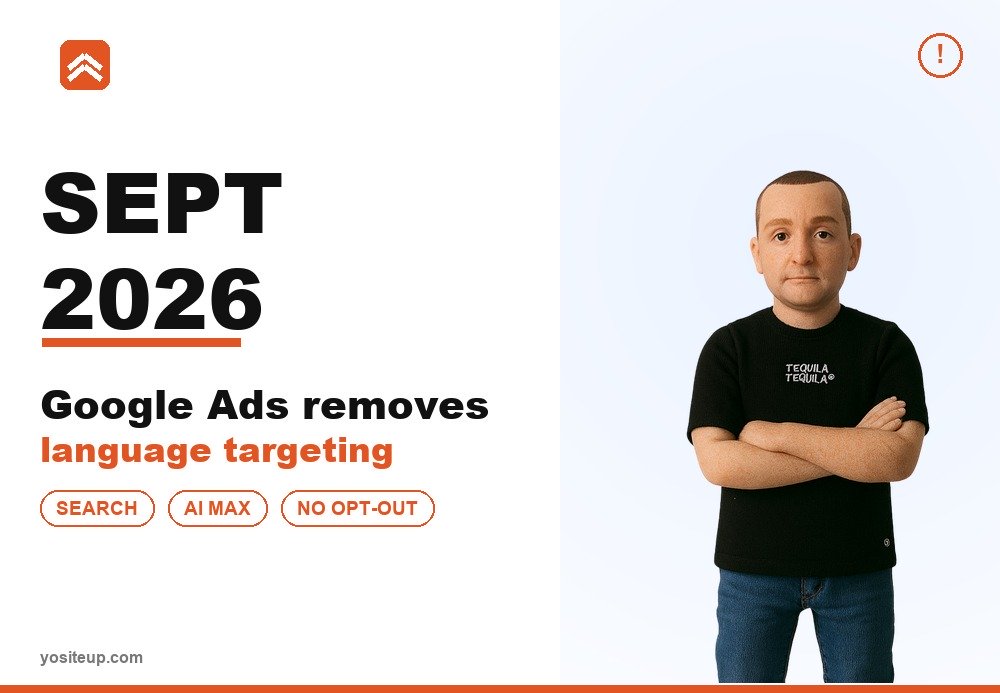
On August 14, 2026, Google's Ads Product Liaison Ginny Marvin announced on LinkedIn that campaign-level language targeting is being removed from Search campaigns and AI Max for Search campaigns, with rollout starting in late September 2026. For agencies and in-house teams running Poland-targeted accounts that mix Polish and English creative - common among international companies with a Poland office, or Polish exporters targeting business buyers abroad - this changes how ads get matched to searchers without any action required on your part.
The change has been on Google's roadmap since an original end-of-2025 target, then slipped twice before this confirmed date. Accounts that treated the earlier announcements as low priority now have a firm window to review campaign structure before the manual setting disappears.
What Changes Under the Hood
The language targeting setting under campaign settings is removed for Search campaigns and AI Max for Search campaigns. Instead, Google's system infers language from your ad creative, your landing page, and signals about what language the searcher understands - browser and account language settings plus the language of the query itself. The system favors the ad and landing page combination whose language matches the search query.
This matters differently depending on account structure. A campaign that keeps Polish creative and Polish landing pages fully separate from English creative and English landing pages continues to work the same way it does today, since Google reads that separation directly from the assets. A campaign that mixes Polish and English ad groups under one roof, relying on the language setting to route traffic correctly, loses that routing mechanism.
Why Poland-Market Accounts Should Pay Close Attention
A meaningful share of Poland-targeted accounts run bilingual structures for a specific reason: international brands entering the Polish market often launch with English corporate messaging before fully localizing, while Polish companies exporting to Western Europe or targeting international B2B buyers frequently run English campaigns alongside Polish ones from the same account. Both patterns commonly started as a single campaign with language settings splitting delivery, rather than as separate campaigns from day one.
Poland is also a market where Google holds over 95% search share, and competition on Google.pl against local players in e-commerce, comparison shopping on Ceneo.pl, and B2B software is dense enough that a language mismatch showing English ad copy to a Polish-language query, or vice versa, can waste budget quickly in a market where average budgets tend to run lower than in Western Europe.
The Performance Max Split Advertisers Are Missing
Performance Max campaigns follow a different rule than standard Search campaigns, and Poland-market accounts running Performance Max for e-commerce or lead generation need to understand the split. Language settings no longer apply to the Google Search results delivered through Performance Max - the same creative and landing page matching used in Search campaigns applies there. But language settings continue to guide delivery across YouTube, Display, Discover, and Gmail placements inside the same campaign. Shopping ads served through Performance Max, heavily used by Poland-focused e-commerce advertisers competing on price comparison, are unaffected by this change entirely.
Language Exclusions Still Do Not Exist
Nothing about this update adds the ability to exclude a language from targeting. Google Ads has never offered that control, and advertisers hoping the new signal-based system would finally let them block ads from a specific language segment will find the gap unchanged - the system can favor a match, it cannot enforce an exclusion.
API Access for Agencies Managing Multiple Poland Accounts
Agencies managing several Poland-targeted client accounts through the Google Ads API, common where one team handles bulk campaign setup and reporting across accounts, need to check their tooling specifically. Starting with the late September 2026 rollout, API calls that set or read language criteria for Search campaigns will return an error. If a shared script or management platform touches language targeting across multiple client accounts, that single piece of code needs fixing once, before the rollout, rather than being rediscovered separately when each client account starts throwing errors.
What to Check Before Late September
- List every active Search and AI Max for Search campaign in Poland-targeted accounts that currently uses language targeting.
- Confirm whether Polish and English (or any other language pair) run as fully separate campaigns already, or are mixed inside a single campaign structure relying on the language setting.
- Where languages are mixed in one campaign, plan a split into language-specific campaigns before late September if precise control over Polish versus English delivery matters for the account.
- Audit landing pages for language consistency - a Polish-language ad pointing to a partially translated or English-only landing page is exactly the mismatch this change makes more likely.
- Check every API integration or bulk management tool connected to Poland-market accounts for language criteria calls, and remove that code before the rollout.
- Review Performance Max campaigns separately for Search placement behavior versus YouTube, Display, Discover, and Gmail placement behavior within the same campaign.
Accounts that already keep Polish and English fully separate, each with matching creative and landing pages, have the least to do here - this becomes a quick structural confirmation rather than a rebuild.
Same Direction as Recent AI Max Changes
This removal sits alongside the AI Max auto-upgrade rollout that converts eligible Search campaigns automatically based on existing settings. Both changes move decisions advertisers used to configure manually toward automated signal matching. For Poland-market accounts already adjusting to broader AI Max search term matching, tightening negative keyword and brand exclusion lists becomes even more relevant once language matching also shifts from a manual setting to an inferred signal.
Agencies running multiple Poland-market accounts should build this into a recurring account review rather than treating late September as a single deadline to clear.
FAQ
Does this change apply to all Poland-targeted accounts equally?
Yes. The rollout applies globally to Search campaigns and AI Max for Search campaigns with no market-specific exemption for Poland-targeted accounts. What differs by market is exposure - accounts mixing Polish and English inside single campaigns have more to review than accounts already separated by language.
Why is this particularly relevant for international companies operating in Poland?
International brands entering the Polish market often run bilingual accounts with English corporate creative alongside Polish localized creative, sometimes inside a single campaign relying on the language setting to route traffic. Once that setting is removed, correct routing depends entirely on clean creative and landing page separation.
Does the Performance Max exception matter for Poland e-commerce advertisers?
Yes, especially for e-commerce accounts competing on Ceneo.pl price comparisons. Shopping ads within Performance Max are unaffected by this change, but the Search placement inside the same Performance Max campaign follows the new signal-matching rule, while YouTube, Display, Discover, and Gmail placements keep using language settings as before.
What should agencies managing multiple Poland client accounts prioritize first?
Checking shared API tooling and bulk management scripts for language criteria calls on Search campaigns, since a single piece of broken code can affect every client account it touches at once, not just one account.