

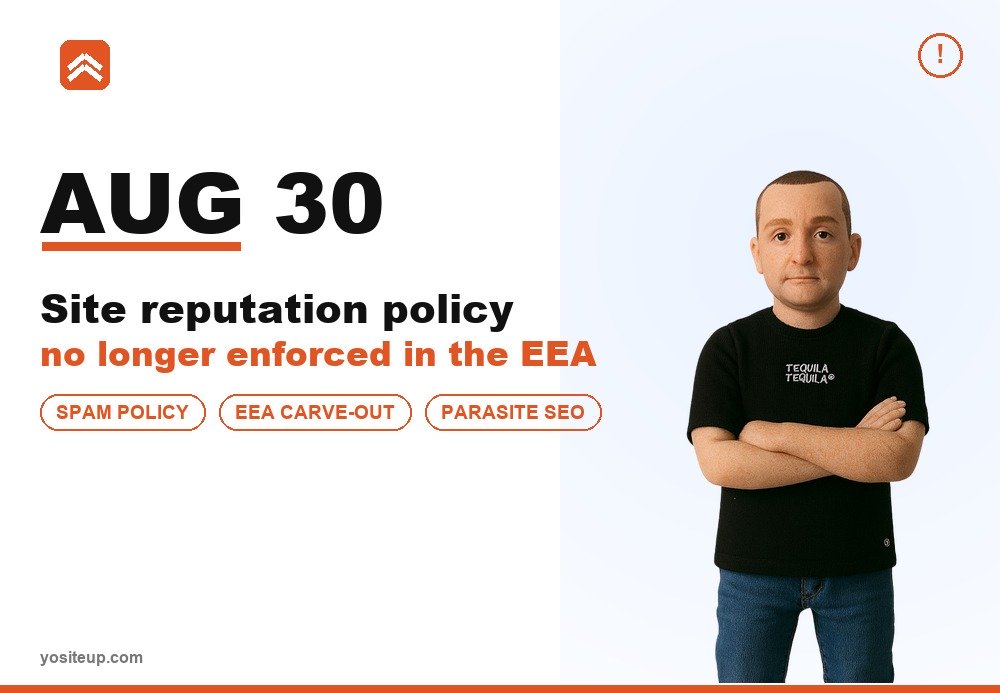
On August 30, 2026, Google stopped enforcing one of its core spam manual actions the same way everywhere. For searches made by users physically inside the European Economic Area, a site reputation abuse manual action no longer demotes an entire website - only a narrower, technical remedy applies. Ukraine is not part of the EEA, so this specific rule does not change anything for search traffic coming from Ukraine. What it does change is the precedent other regulators, including ones outside the EU, now have to point to.
What the Policy Punishes
Google's site reputation abuse policy targets parasite SEO: a weak, unrelated publisher places sponsored content - casino affiliate pages, loan comparison sections, coupon aggregators - inside a strong, established domain to borrow its search authority. The standard enforcement is a manual action that demotes the entire host domain, not just the offending section, wherever it is searched from.
What Actually Changed, and Where
Since August 30, 2026, that full-domain demotion no longer applies to results shown to users searching from inside the EEA. Instead, Google can separate the flagged section technically so it ranks on its own, weaker signals, without dragging down the rest of the domain for that specific audience. For any search made from outside the EEA - including all of Ukraine - the older, full-strength manual action still applies exactly as before. Nothing about ranking behavior for Ukrainian search traffic has changed because of this update.
Why a Regional Carve-Out Still Matters for a Non-EEA Market
The interesting part of this story is not the specific policy - it is how Google was made to change it. The European Commission opened a Digital Markets Act investigation after publishers argued the policy swept up legitimate white-label commercial deals along with real parasite SEO schemes, and Google adjusted enforcement rather than risk a fine of up to 10% of global annual revenue. That is a template: regulatory pressure producing a geography-specific concession to a core spam policy, rather than a uniform global change driven by Google's own judgment. Regulators and lawmakers in other regions, including ones shaping digital-market rules well beyond the EU, tend to study exactly this kind of outcome when drafting their own proposals.
What This Means for Sites Operating in the Ukrainian Market
- No immediate ranking change for search traffic coming from Ukraine - the older enforcement continues in full.
- Any site with meaningful traffic from both Ukraine and EEA countries now effectively runs under two different enforcement outcomes for the exact same manual action, split purely by where each visitor is searching from.
- If regulatory pressure eventually produces similar region-specific carve-outs elsewhere, sites that already track this precedent will be better positioned to understand what changes and what does not when it happens.
- The underlying practice - borrowing a stronger domain's authority through an unrelated sponsored section - remains risky everywhere, including for traffic from Ukraine, regardless of this EEA-only change.
Frequently Asked Questions
Does this change anything for search results shown to users in Ukraine? No. Ukraine is outside the EEA, so the manual action for site reputation abuse still applies with full force there, exactly as before August 30, 2026.
Why is a rule that does not apply to Ukraine still worth tracking? Because it establishes that Google will split enforcement of a core spam policy along regulatory lines when a regulator forces the issue - a pattern that could reach other jurisdictions later.
Is the underlying tactic - hosting sponsored content on a stronger domain - now safer anywhere? No. Even inside the EEA the flagged section still loses most of its ranking power once separated; outside the EEA the full manual action still applies.
Could Ukraine eventually see a similar carve-out? Nothing has been announced, and Ukraine is not part of the EEA or subject to the Digital Markets Act, so there is no direct mechanism for this specific rule to extend there.
Does this affect Search Console reporting for sites targeting Ukraine? No, Search Console manual action notices and the reconsideration process are unaffected everywhere, including for Ukraine-focused sites.
Should agencies working with Ukrainian clients still read about this? Yes, mainly to understand the mechanism - regulatory pressure producing geography-specific spam enforcement - since similar mechanisms could eventually surface in other markets.
Bottom Line
Nothing about how Google ranks search results for users in Ukraine changed on August 30, 2026. What changed is that Google now enforces one of its spam policies differently depending on where the search happens, after a regulator forced the issue. That precedent, more than the specific rule itself, is the part worth remembering even for a market the rule does not currently touch.
Related reading: Google's August 2026 Spam Update - full breakdown.