What's Really Holding Back Your Google.com.ua Rankings
Sites plateau on Google.com.ua for reasons that a generic checklist rarely catches - broken internal links, duplicate meta data, slow pages, missing structured markup. We audit against what actually affects Ukrainian search results specifically, then hand you a fix list sorted by real impact, not by which item is easiest to check off. YOSITE UP!

General audit of your website
SEO SITE AUDIT
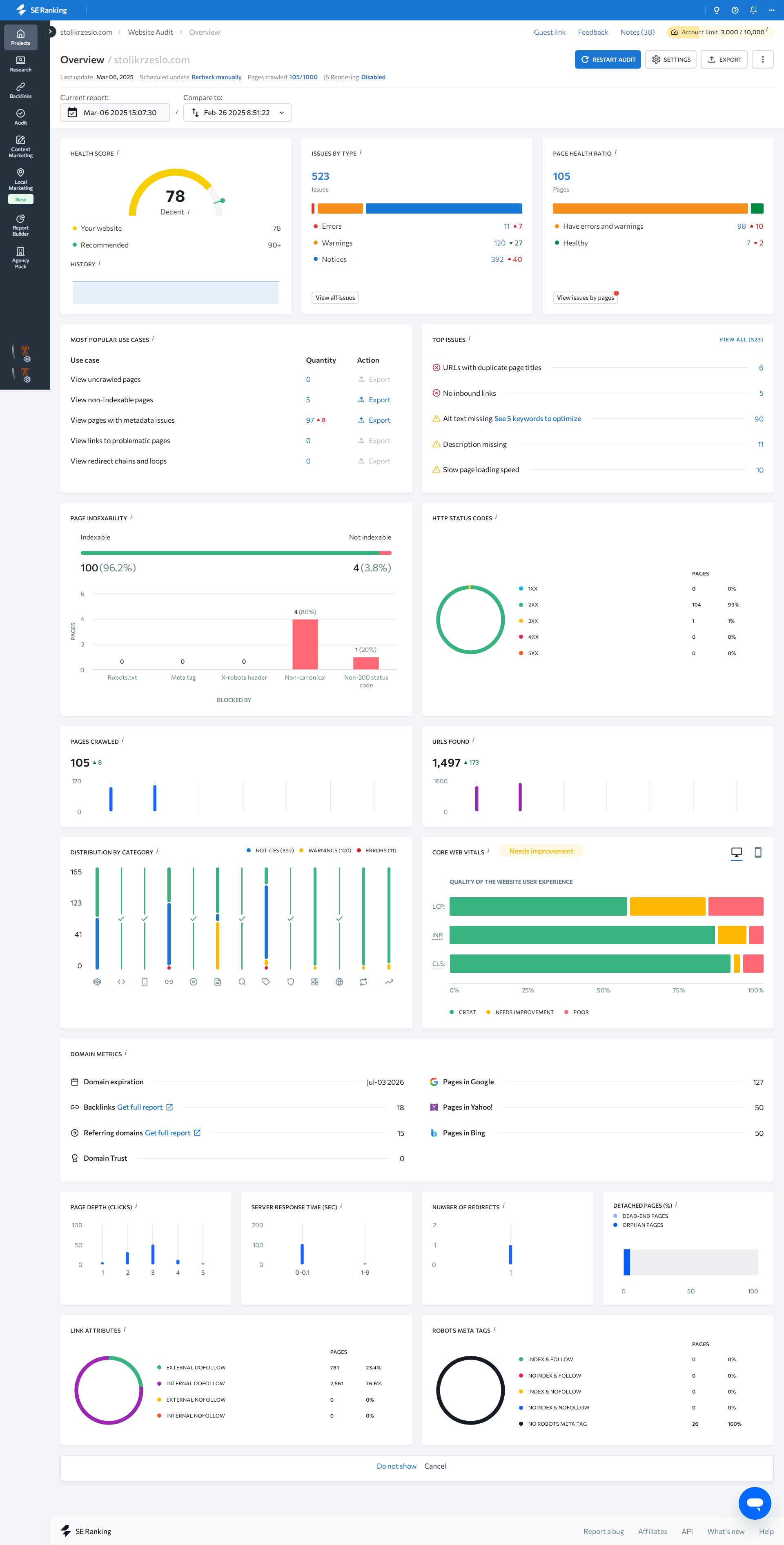
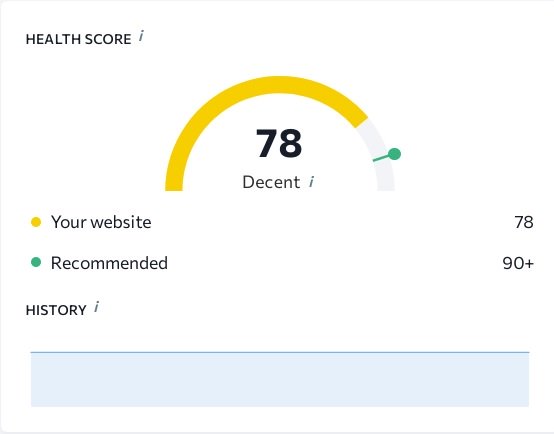
A website audit will reveal the main shortcomings of the website in terms of internal optimisation. Internal optimisation will improve your website's performance in search engine results. We provide a report on the SEO performance of the website's HEALTH SCORE before and after the work is completed.
Why conduct a SEO audit of a website
Regular SEO audits let you respond quickly to Google algorithm updates, continuously improve your website's structure, and maintain the conditions for stable organic traffic growth from Ukrainian users. For any website that takes its Google.com.ua performance seriously, a professional audit is the essential starting point.
Solving problems with the site
A professional SEO audit for Google.com.ua identifies and eliminates the critical errors that block effective promotion in Ukrainian search. The most common issues we find include:
Slow page loading - especially on mobile devices, which directly impacts Google.com.ua rankings
Indexing problems - pages not being crawled or appearing in Google search at all
Duplicate or non-unique content - identical pages diluting your website's authority
Missing or incorrect meta tags - preventing Google from correctly displaying your pages in Ukrainian search results
Poor mobile adaptation - critical for Google.com.ua rankings in 2026
Structural and navigation issues - making it difficult for Google to understand your content hierarchy
Resolving these issues significantly improves your website's chance of ranking in the top positions on Google.com.ua and attracting targeted Ukrainian visitors who convert.
SEO Site Audit for Ukrainian-Market Sites: What We Check and What You Receive
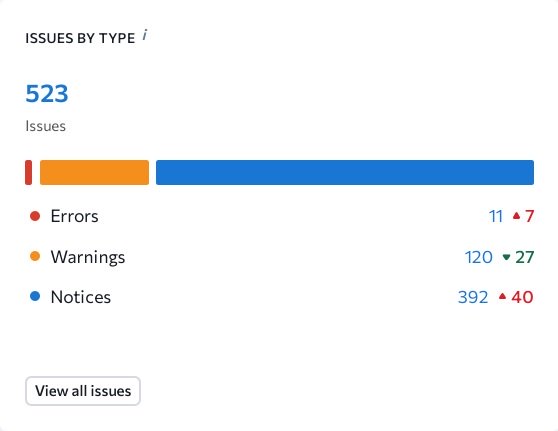
The SEO site audit is the first stage of your SEO Optimization package. For Ukrainian-market sites, the audit produces the same three core indicators as the standard version - Health Score, Issues by Type, and Page Health Ratio - using data sources and benchmarks calibrated to Google.ua and the current Ukrainian web landscape.
Ukrainian sites present a distinct set of technical patterns that require a different audit lens than Western European or US sites. Many Ukrainian sites have gone through significant restructuring since 2022: domain zone migrations, language restructurings from Russian to Ukrainian, platform changes, and hosting migrations. Each of these transitions leaves technical residue that shows up in an audit as redirect chains, canonical misconfigurations, hreflang errors, and duplicate content. This page explains what the audit covers for your site specifically.
Three Metrics in the Audit Report
Health Score
A composite score (0-100) reflecting the overall SEO condition of your site. For Ukrainian-market sites, we benchmark against current Ukrainian-market norms:
A Ukrainian business site on Bitrix with no deliberate SEO history typically scores 30-50 - Bitrix's default URL generation creates duplicate content patterns that drag the score. A Ukrainian WordPress site with WPML and standard configuration typically scores 35-55 depending on how the multilingual setup was done and whether hreflang was configured. A Ukrainian OpenCart store without SEO configuration often scores 25-40.
Sites that have gone through a Russian-to-Ukrainian language transition without full technical cleanup typically score 25-45 - below the Ukrainian market average - due to accumulated redirect chains, hreflang inconsistencies, and mixed-language on-page signals.
We target a minimum Health Score of "Decent" (60+) as the package outcome. Ukrainian sites in the 30-45 starting range typically reach 63-72 after all five package stages.
Issues by Type
A full list of errors grouped by category: technical errors (crawl blocks, redirect issues, server-level problems), on-page errors (missing or duplicate title tags, missing H1, thin content), content errors (duplicate pages, low word count), and speed issues (Core Web Vitals failures).
For Ukrainian sites, Issues by Type consistently shows elevated counts in: redirect chain issues (migration history), hreflang errors (language transition), duplicate content from Bitrix or OpenCart URL patterns, and thin English-language pages where Ukrainian companies created an en-UA version without adequate content.
Page Health Ratio
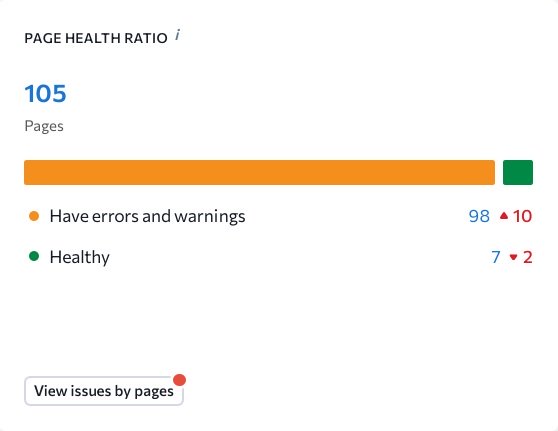
The percentage of pages free of critical and warning-level errors, measured before and after the package. For Ukrainian sites that have gone through language and domain migrations, the starting Page Health Ratio is often low (40-55%) because redirect issues and canonical errors affect a wide proportion of pages simultaneously. After package corrections, Ukrainian sites typically reach 72-82% Page Health Ratio.
What the Audit Checks for Ukrainian Sites
Google Search Console data filtered to Ukraine
We begin with your Google Search Console data filtered to Ukraine. GSC shows which pages Google has crawled and indexed for your site in Ukraine specifically, which pages are excluded and why, and which Ukrainian queries your pages already appear for. For Ukrainian-market packages, GSC filtered to Ukraine is the primary data source - global GSC data does not distinguish Google.ua performance from other markets.
Common GSC findings specific to Ukrainian sites in 2025:
- "Duplicate, submitted URL not selected as canonical": Common on Ukrainian Bitrix sites and OpenCart stores with multiple URL paths for the same content
- "Page with redirect": Russian-language URL versions that were submitted to the sitemap but now redirect to Ukrainian-language versions - these should be updated in the sitemap
- "Crawled - currently not indexed": Often thin English-language pages on Ukrainian B2B sites, or automatically generated Ukrainian e-commerce pages with near-duplicate content
- "Discovered - currently not indexed": Product pages on Ukrainian e-commerce sites where Googlebot has found links but deprioritized crawl allocation due to perceived low quality of neighboring pages
Technical crawlability for Ukrainian CMS configurations
We verify Googlebot access for each CMS type common in Ukraine:
- 1C-Bitrix: `.htaccess` correctness for Bitrix's URL rewriting, the Bitrix composite mode interaction with crawlability, Bitrix-generated sitemap accuracy, and whether both parameter-based and SEF URLs are simultaneously accessible
- Joomla (Ukrainian installations): SEF URL activation status, `.htaccess` activation, Joomla redirect component history from Russian-to-Ukrainian alias changes, and language filter plugin configuration
- WordPress with WPML/TranslatePress: Language-specific sitemap accuracy, hreflang tag consistency across all pages, canonical tag per language version, and whether the WordPress "discourage search engines" setting is disabled
- OpenCart: SEO URL feature status, `.htaccess` correctness, URL alias table accuracy after slug changes
Indexation status with Ukrainian-specific exclusion patterns
Beyond crawlability, we check what Google.ua has actually indexed for your domain. Ukrainian-specific indexation patterns we look for:
- Russian-language URL versions still indexed alongside Ukrainian-language versions - a sign that 301 redirects were implemented at the CMS level but not processed by Googlebot yet, or that old URLs are still referenced in inbound links
- Language version confusion where Google has indexed Ukrainian-language pages in its Russian-language cluster - caused by incorrect hreflang language codes (`ru` instead of `uk`)
- Ukrainian e-commerce category pages indexed for some URL variants but not others - where Bitrix or OpenCart generates multiple paths to the same category
- Previous domain zone (`.com.ua`) pages still showing in Google's index after migration to `.ua` - indicating that the old domain zone is still accessible rather than redirected
On-page elements for Ukrainian and English Ukrainian-market pages
Every page is checked for: title tag presence and uniqueness, meta description presence and uniqueness, single H1, heading hierarchy, image alt attributes, and internal link count and anchor text.
For Ukrainian-language pages, we additionally note:
- Whether the current title and H1 use Ukrainian or Russian (for sites that did not complete the language transition in all elements)
- Whether on-page keyword targeting reflects current Ukrainian search query phrasing or pre-2022 Russian-dominant phrasings
- Whether Bitrix's auto-generated title patterns produce relevant or keyword-irrelevant titles
For English Ukrainian-market (en-UA) pages, we note whether content depth is adequate - Ukrainian companies' English pages are frequently thin, underserving the international B2B audience they are meant to reach.
Page speed and Core Web Vitals for Ukrainian users
We measure LCP, CLS, and INP using PageSpeed Insights field data for real Ukrainian users and lab data. Ukrainian mobile users are the primary benchmark. Key speed findings on Ukrainian sites:
- High LCP on mobile is common on Ukrainian sites with hosting on budget shared plans - TTFB often exceeds 1.5 seconds before a single byte of content is served
- CLS issues appear frequently on Ukrainian sites using older Joomla or custom PHP templates with dynamically loaded ad or banner elements
- INP (Interaction to Next Paint) - the replacement for FID in Core Web Vitals - is often elevated on Ukrainian sites with heavy Bitrix component loading
Speed issues that can be fixed within the package (image compression, render-blocking scripts, cache headers) are passed to the fixes stage. Infrastructure-level speed issues (hosting tier, no CDN) are documented with recommendations.
Duplicate content with Ukrainian-specific URL patterns
We identify all duplicate URL pairs and their sources:
- Russian-slug and Ukrainian-slug versions of the same page both resolving without redirect
- Bitrix parameter URLs and SEF URLs both accessible
- OpenCart products accessible via multiple category paths
- www/non-www and http/https both resolving (common after Ukrainian hosting migrations where the old domain configuration was not fully retired)
- Ukrainian e-commerce filter and sort parameter pages generating thin duplicate listings
Hreflang audit for Ukrainian multi-language sites
Ukrainian sites with Ukrainian and Russian language versions, or Ukrainian and English versions, require correct hreflang implementation. We audit:
- Whether hreflang language codes are correct: `uk` for Ukrainian (not `ua`, which is not a valid language code), `ru` for Russian, `en` for English (with `en-UA` for English Ukrainian-market targeting)
- Whether hreflang tags reference the correct canonical URL for each language version
- Whether hreflang is implemented consistently - present on all pages of all language versions, or absent and inconsistent
- Whether x-default hreflang is implemented and points to the appropriate version
Competitor benchmarks for Ukrainian market
At Package 100 and Package BIG, we pull Health Score equivalents for 3-5 direct Ukrainian competitors using the same audit methodology. Ukrainian competitor Health Scores vary more widely than in Western markets - some established Ukrainian businesses have made significant SEO investments, while others have none. The competitor benchmark shows where your site stands relative to the actual Ukrainian SERP competitors you will be displacing.
Local search audit - Kyiv and regional Ukrainian cities
For Ukrainian businesses targeting city-level searches, we audit whether location-relevant pages exist and are indexed. Common finding: Ukrainian service businesses have content targeting national queries but no city-specific pages for Kyiv districts, Lviv, Dnipro, or Odesa - missing the high-intent local traffic that converts at higher rates than national queries.
How Scope Scales by Package
Package 20 ($199): Full audit across up to 20 pages. All categories checked. For a Ukrainian service business site, this covers the complete indexable site. Typical completion: 2-3 business days.
Package 50 ($349): Full audit across up to 50 pages. Includes Ukrainian blog content, OpenCart category structure, and WPML language version mapping. Typical completion: 3-4 days.
Package 100 ($599): Full audit across up to 100 pages. Template-level issues reviewed - particularly relevant for Bitrix sites where template-level errors affect multiple page types simultaneously. Includes competitor Health Score benchmarks for 3-5 Ukrainian competitors. Typical completion: 4-6 days.
Package BIG ($1,199): Full audit of 100+ pages. Automated crawl supplemented by manual review of high-priority pages and all template types. Includes full duplicate URL map and hreflang consistency audit across all language versions. Typical completion: 1-2 weeks.
Common Findings on Ukrainian Sites
Russian-language canonical tags remaining after language transition: A Ukrainian site where the canonical tag on Ukrainian-language pages still points to the old Russian-language URL - caused by template-level canonical implementation that was not updated when language versions were restructured.
Bitrix sitemap including both SEF and parameter URLs: A Bitrix-generated sitemap listing both `/catalog/product-name/` and `/catalog/?ELEMENT_ID=42` for the same product - causing Googlebot to crawl and attempt to index both variants.
WPML hreflang with wrong language code for Ukrainian: Using `ua` instead of `uk` as the language code for Ukrainian-language pages - `ua` is not a recognized language code and produces a hreflang error across all pages on the site.
OpenCart URL aliases not updated after product name changes: Product URL slugs that were changed in OpenCart but where the old alias was not removed - causing both old and new slugs to resolve, creating URL-level duplicates for every renamed product.
English pages with 80-150 words: Ukrainian B2B companies with English-language pages written for international clients that contain a single short paragraph and a contact form - insufficient content for Google.ua to index and rank the page for any English-language Ukrainian market query.
Frequently Asked Questions
Our site went through a `.com.ua` to `.ua` domain migration. Will the audit catch all the redirect issues? Yes. Domain zone migration redirect issues are among the most common findings on Ukrainian sites. The audit traces all redirect chains from the old domain through to the current live URLs and identifies every case where chains exceed one hop, loops exist, or old URLs still resolve without redirect.
Do you audit Ukrainian and Russian language versions separately? The audit covers all language versions of your site within the package scope. We check each language version for its own technical correctness and note cross-language issues (hreflang consistency, canonical relationship between versions) as a separate category in the Issues by Type section.
How do you access GSC data for our Ukrainian site? You provide Google Search Console access for your site's property - view-only access is sufficient for the audit. We filter data to Ukraine for Ukrainian-market analysis and separate data by language version where your GSC shows language segmentation.
Can you audit a Bitrix site with a catalog of 500+ products within a single package? Package BIG covers 100+ pages at full audit depth. For Bitrix catalogs with 500+ product pages, the audit collects crawl data across all pages and provides technical analysis. Optimization (title/meta corrections) is applied to the priority pages within your package scope. Lower-priority product pages receive audit documentation and a corrections plan.
What if our Ukrainian site has no Google Search Console set up? We can conduct the audit using crawl tool data (Screaming Frog or Sitebulb) and PageSpeed Insights without GSC access. However, GSC provides indexation status data that cannot be replicated by crawl tools alone. We recommend setting up GSC before the package begins - the setup process takes 1-2 days for DNS verification, which can run concurrently with the initial audit setup.
Last post
From our blog

A Google Bug Is Unlinking Local Service Ads Accounts - What Ukraine's Outsourced Marketing Teams Should Check
Ukraine's AdSense Publishers Will See Lower Numbers on February 17, 2027 - Here's the Real Reason