See Exactly What Changed on Google.com.ua
It's easy to pay for SEO work and never really know what happened. We close that gap: every report names the specific errors found on your site, the exact fixes applied, and includes a follow-up audit proving those fixes hold up. Nothing summarized away - you can check every claim against the live site yourself. YOSITE UP!

We will send you a full report
WORK REPORT
After completing SEO optimisation work, we will prepare and send you a detailed report. The report will include a website audit after the errors have been corrected. It will list all the errors that have been corrected and that affect the website's position in Google. You will receive a transparent picture of the work done and see how the improvements have affected the visibility of the resource.
WORK REPORT
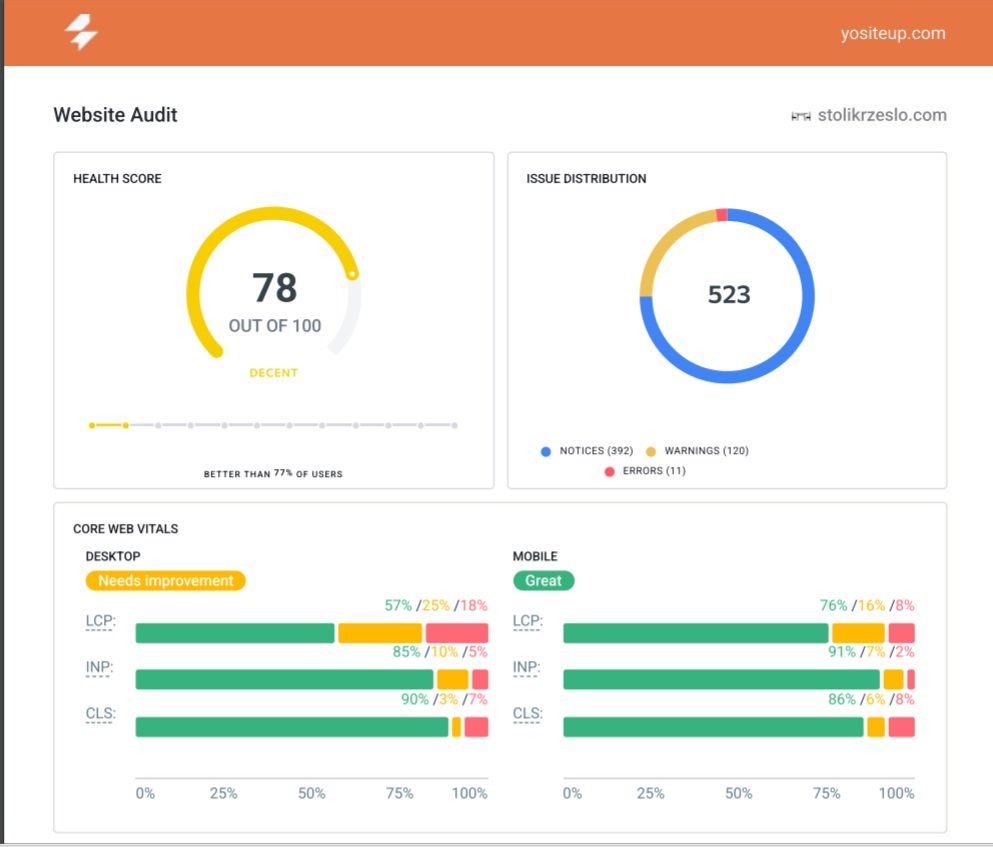
An example of a website SEO audit report. The overall result of the website is shown. The items and pages on which work was carried out are described in detail.
What does SEO audit give
Key phrases and SEO audit
Alongside the post-work SEO audit, your report includes a complete list of key phrases researched and selected specifically for your website's pages, targeting real search demand on Google.com.ua. Each phrase is chosen based on what your potential customers in Ukraine actually type into Google, and all selections meet Google's current criteria for relevance, search volume, and commercial intent. Implementing these keywords across your content makes each page more visible in Ukrainian search and helps your website rank higher for the queries that matter most in Google.com.ua in 2026. This keyword list is the foundation for all further content and link-building work.
Work Report: What You Receive When Your Ukrainian-Market SEO Package Is Complete
The work report is the final deliverable of the SEO Optimization package. It is sent after all five stages are finished: site audit, keyword research, content optimization, technical fixes, and the closing audit. For Ukrainian-market sites, the report uses data and benchmarks specific to Google.ua, current Ukrainian keyword volumes, and the Ukrainian competitive landscape.
Here is what the report contains and how Ukrainian-market data appears in each section.
What the Work Report Includes
Before and after Health Score comparison
The report opens with your site's Health Score before work began and after all corrections were applied, generated by the same audit methodology - the comparison is direct and verifiable.
For Ukrainian sites, the starting Health Score context matters. A Ukrainian service business site on WordPress or Joomla that has not had deliberate SEO work typically starts at 35-50. A Bitrix-based site with no SEO configuration often starts at 28-45 due to Bitrix's default URL duplication patterns. A Ukrainian site that underwent a language transition from Russian to Ukrainian without full technical cleanup may start at 25-40 - below market average - due to accumulated redirect chains, hreflang errors, and canonical inconsistencies.
After the full package, Ukrainian sites in these starting ranges typically finish at 63-73. The report explains which specific changes drove the improvement - not just numbers but the causal link between the fixes applied and the score outcome.
Page Health Ratio before and after
Alongside the Health Score, the report shows the Page Health Ratio - the percentage of your site's pages free of critical and warning-level errors - before the package and after. For Ukrainian sites that went through domain or language migrations, the starting Page Health Ratio is often lower than the Health Score suggests, because redirect chain and hreflang errors affect a large share of all pages simultaneously. After package corrections, Ukrainian sites typically show Page Health Ratio improvement of 25-35 percentage points.
Keyword map for Google.ua
The keyword map in the work report reflects Ukrainian-market data throughout. Each page in your package receives its assigned primary keyword, secondary variants, monthly search volume on Google.ua (sourced from Ahrefs or Semrush Ukrainian database), and keyword difficulty calibrated to Ukrainian SERP competition.
Ukrainian keyword volumes are lower than equivalent US or UK figures - this is accurate market data, not a data gap. A business service keyword showing 5,000 monthly searches globally may show 200-600 on Google.ua. The Ukrainian market is smaller, but traffic from Google.ua for Ukrainian-specific queries has a higher commercial specificity - users searching in Ukrainian for local services have narrowed intent that converts at competitive rates.
The keyword map is yours permanently after the package. It can be used for:
- Ukrainian-language content planning: blog posts, service page additions, city-specific landing pages
- Google Ads targeting for the Ukrainian market, using the volume and difficulty scores as a guide for bid strategy
- Briefing Ukrainian copywriters or a Ukrainian marketing team with keyword targets and priority ordering
- Baseline reference for a follow-on audit 6-12 months later
The map notes the keyword language for each entry: Ukrainian-language (uk-UA), Russian-language in Ukraine (ru-UA), or Ukrainian-market English (en-UA). For sites with multiple language versions, keywords for each version are listed separately.
Full list of corrections made per page
Every change applied during content optimization (stage 3) and fixes (stage 4) is listed by page URL with before and after values. For Ukrainian sites, this section includes language-specific corrections:
- Title tag changes from Russian-language text to Ukrainian-language text on pages that completed language transition in body content but not meta elements
- H1 corrections where Ukrainian keyword inflection did not match the dominant search form
- Canonical tag corrections - including Bitrix parameter-URL canonical misconfigurations, WPML hreflang language code fixes (`ua` corrected to `uk`)
- Redirect chain consolidations from domain zone migrations (`.com.ua` → `.ua`) and language restructurings
- Image alt attribute additions or corrections - in Ukrainian for Ukrainian-language pages, in English for en-UA pages
- robots.txt changes where Ukrainian CMS configurations blocked pages unintentionally
Each entry in the corrections list gives you the page URL, the specific element, the before value, and the after value. You can verify any correction against your live site using a meta tag inspection tool or your CMS's page editor. No SEO knowledge is required to confirm a change - you compare the listed value against the current field content.
Issues identified but outside package scope
The Ukrainian web landscape frequently surfaces issues that require work beyond the package scope:
- Hosting-tier speed problems (slow TTFB on Freehost, budget Mirohost plans) that require hosting upgrade or CDN implementation
- Bitrix catalog architecture issues that generate URL duplication at the platform level, requiring Bitrix developer work to resolve at the source
- Pages outside the package page count where errors were identified but not corrected
- Russian-to-Ukrainian content translation needed on pages where the language transition was not completed
- Backlink profile issues - Ukrainian sites in competitive niches sometimes have thin or low-quality backlink profiles that limit ranking potential beyond what on-page optimization can address
Each item includes the error type, affected pages, and a specific recommendation. For Bitrix-specific development items, recommendations include what type of Bitrix developer knowledge is needed.
Google.ua ranking positions for target keywords
For sites with 3+ months of Google Search Console history filtered to Ukraine, the report includes current ranking positions on Google.ua for primary keywords assigned in the keyword map. These are live positions at time of report delivery - a starting-point benchmark.
Ukrainian site ranking movements after the package follow a predictable pattern: initial position improvements on long-tail Ukrainian-language queries (city-specific service queries, niche B2B queries) typically appear within 4-6 weeks. Broader keyword improvements for more competitive national Ukrainian queries appear over 8-12 weeks as Google processes the full set of optimized pages.
For sites that started with Russian-primary keyword targeting and shifted to Ukrainian-primary during the package, position data in the report represents positions for Ukrainian-language keywords that may be newly assigned - these starting positions (often not in top 50) are the baseline from which Ukrainian-language ranking builds over the following months.
Timelines for Ukrainian-Market Packages
Package 20 ($199): 10-15 business days from CMS access confirmed to work report delivery. Typical Ukrainian service business (WordPress, Joomla, or Bitrix), homepage, service pages, contact. Consistent with this timeline.
Package 50 ($349): 15-20 business days. Includes Ukrainian blog post optimization, OpenCart category-level work, and WPML hreflang corrections.
Package 100 ($599): 20-30 business days. Template-level corrections for Bitrix or Joomla sites are the primary time variable - testing is required before applying template-level changes to ensure no unintended effects on other CMS-generated content.
Package BIG ($1,199): 30-45 business days depending on site complexity. Ukrainian e-commerce sites and content-heavy Ukrainian portals at this scale require systematic work on canonical correction, redirect chain consolidation across multi-year migration history, and hreflang consistency across language versions.
Access availability is the most common timeline variable for Ukrainian sites. If the site was built by a Ukrainian web studio that still manages admin access, retrieving credentials from them can take several business days. The package timeline begins from confirmed working CMS access.
What "Decent" Health Score Means for Ukrainian Market Sites
A Health Score of 60+ (Decent) is the minimum package target. For the Ukrainian market in 2025:
A score of 60-74 places your site above the average for Ukrainian service and business sites that have not had professional SEO work. Ukrainian competitor sites in most service categories score 35-55 without active SEO investment. Reaching 60+ puts fewer technical barriers between your content and Google.ua rankings than most Ukrainian competitors have.
A score of 75+ ("Good") is achievable for Ukrainian sites starting at 40+ with primarily on-page and redirect issues. Sites with structural Bitrix catalog duplication, hosting-tier speed problems, or incomplete language transitions may reach 63-70 within one package cycle. Pushing beyond 70 may require a hosting upgrade, Bitrix developer work, or a follow-on package that extends scope to remaining issues.
How to Use the Report After Delivery
Verify corrections on your live Ukrainian site: The report gives you specific page URLs and element-level before/after values. For Bitrix sites, verify via the Bitrix admin panel element properties. For WordPress, via Yoast or Rank Math meta fields. For OpenCart, via the product/category SEO fields in the admin panel.
Share with your Ukrainian developer or web studio: The corrections list is structured to be readable by a Ukrainian web developer without SEO background. If your site's technical maintenance is handled by a Ukrainian web studio, the report gives them the reference point they need for future changes - particularly the redirect chain documentation and hreflang configuration notes.
Use the keyword map for Ukrainian content planning: If you work with Ukrainian copywriters or plan to expand content for Google.ua, the keyword map gives them the exact Ukrainian-language terms, volumes, and priority ordering needed to produce content that targets real Ukrainian search queries.
Monitor Google.ua positions: Check your target keyword positions in Google Search Console filtered to Ukraine monthly for the first three months after report delivery. For Ukrainian-language keywords on newly optimized pages, expect the most visible position movement between weeks 4 and 12. For sites that shifted from Russian-primary to Ukrainian-primary keyword targeting, this monitoring shows how the Ukrainian-language keyword cluster is building rankings from the new starting baseline.
Frequently Asked Questions
Our site had a Russian-primary keyword strategy before this package. How does the report handle that? The report treats Ukrainian-primary and Russian-Ukrainian-market keywords separately in the keyword map. For pages that previously targeted Russian-language queries and now target Ukrainian-language queries, the ranking positions section shows the Ukrainian-language starting positions - which may be low (outside top 50) at report delivery, reflecting the starting point of building Ukrainian-language rankings. The report notes this clearly and provides the expected improvement timeline for Ukrainian-language query positions.
Can I share the work report with an international investor or partner unfamiliar with Ukrainian market SEO? Yes. The Health Score comparison, Page Health Ratio change, and keyword map with volume data are self-explanatory in English. The report includes notes on Ukrainian-specific context (why volumes are lower than global equivalents, what the Ukrainian competitive landscape for your category looks like) that provide background for non-Ukrainian audiences.
What if a Bitrix cache or composite cache is preventing our title tag corrections from appearing? Bitrix composite cache must be cleared after meta tag changes for them to appear in the served HTML. We document the cache clearing step in the report. If the change is still not visible after cache clearing, contact us - we will verify whether the change was applied to the correct Bitrix element or whether a Bitrix component is overriding the meta field.
Does the keyword map include current Ukrainian-language volume data, not pre-2022 data? Yes. We use current Ahrefs or Semrush Ukrainian database data, which reflects post-2022 search behavior on Google.ua. Pre-2022 data would understate Ukrainian-language volumes and overstate Russian-language volumes in many categories. The keyword map reflects the current Ukrainian-language/Russian-language volume distribution for each concept.
What if our Google Search Console has less than 3 months of Ukrainian data? For sites with insufficient GSC history filtered to Ukraine, the ranking positions section of the report is omitted. Instead, the report includes the keyword map with difficulty scores and a note on when position data will become meaningful (typically after 60-90 days of GSC data accumulation filtered to Ukraine). We recommend setting up GSC before the package begins to maximize the data available for the report.
Can the work report be used as a deliverable for our Ukrainian client if we are an agency? Yes. The report format is designed to serve as a client-facing deliverable. The before/after Health Score comparison, the corrections list, and the keyword map are all appropriate for presenting to a Ukrainian business client. We can include your agency's name in the report header on request.
Last post
From our blog

A Google Bug Is Unlinking Local Service Ads Accounts - What Ukraine's Outsourced Marketing Teams Should Check
Ukraine's AdSense Publishers Will See Lower Numbers on February 17, 2027 - Here's the Real Reason