


A hiring manager or a prospective client spends under a minute on a marketing portfolio before deciding whether to keep reading. In that minute they are not checking whether you know what SEO or PPC is. They are checking whether you can prove you moved a number that mattered. Most portfolios fail this test not because the work behind them was weak, but because the page lists skills instead of proving them. This guide covers what a strong digital marketing portfolio actually contains, with separate detail for an SEO specialist, a PPC specialist and a marketer running several channels at once, plus how to handle numbers you are not allowed to share in full.
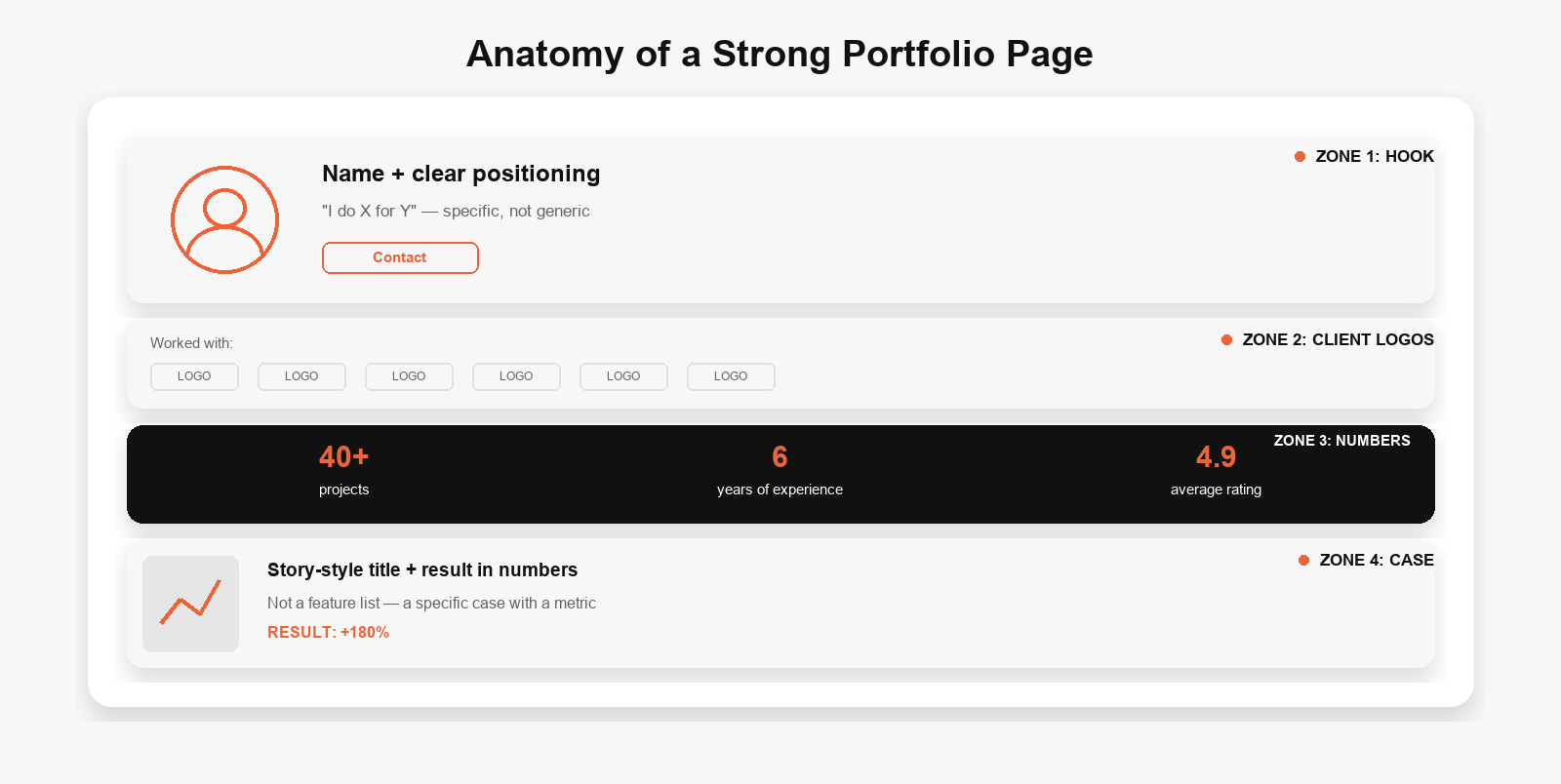
What a Client or Employer Actually Looks at First
Before you get into SEO, PPC or channel-specific cases, it helps to know what actually happens in a reader's head in the first thirty seconds. They do not read the page top to bottom. They scan it and answer three questions, in this order, and if the answer to the first one is no, they never get to the second.
- Is this person relevant to my specific problem? Not "is this a good marketer in general" but "does this person solve what I need right now." A broad, unfocused digital marketing portfolio loses to a narrow SEO portfolio or PPC portfolio almost every time, even when the generalist has more total experience.
- Is there proof they have actually done this before? Not a claim, evidence: client logos, numbers, a case with a result. A reader is scanning for traces of real work, not a list of skills.
- Is there a person behind this who thinks, or just a person who executes a checklist? This is the hardest signal to fake, and it is the one most portfolios skip. It comes through in how a case is written, not in what it claims.
Four elements set the tone before a reader ever opens the first case study.
The positioning line: a weak and a strong example
The difference between a portfolio that holds attention and one that gets closed in ten seconds often shows up in the very first line.
- Weak: "Digital marketing specialist with experience in SEO, PPC and social media."
- Weak for an SEO portfolio specifically: "SEO specialist, I improve search engine rankings."
- Strong: "I get B2B SaaS sites into the top 3 for commercial keywords in 6 to 9 months without buying links."
The first two describe a job title, which the reader can already see from your resume. The third describes a result, a market and a method, and answers the first question directly: does this person solve my specific problem.
- Proof of who you have worked with. A row of client logos, even for small or mid-size clients, does more for credibility in three seconds than a paragraph of self-description. This is a direct answer to the second question: has this person actually done it.
- A number bar. Years of experience, projects delivered, an average rating. Three figures, not a biography, readable in one glance rather than buried in a paragraph.
- One case, not ten. The first case study on the page is doing the selling. It needs a story-style headline and a result, not a list of deliverables. A reader only opens the second case if the first one convinced them.
If your portfolio opens with a skills list, a stock photo and a generic "passionate about marketing" line, a reader has no reason to keep scrolling. Fix the top of the page before you fix anything else.
The Anatomy of a Case That Actually Convinces
Most portfolios describe what was done. The ones that convert describe why it mattered, using a fixed shape: situation, goal, your specific role, the constraints you worked within, the decision you made, and the measurable result.
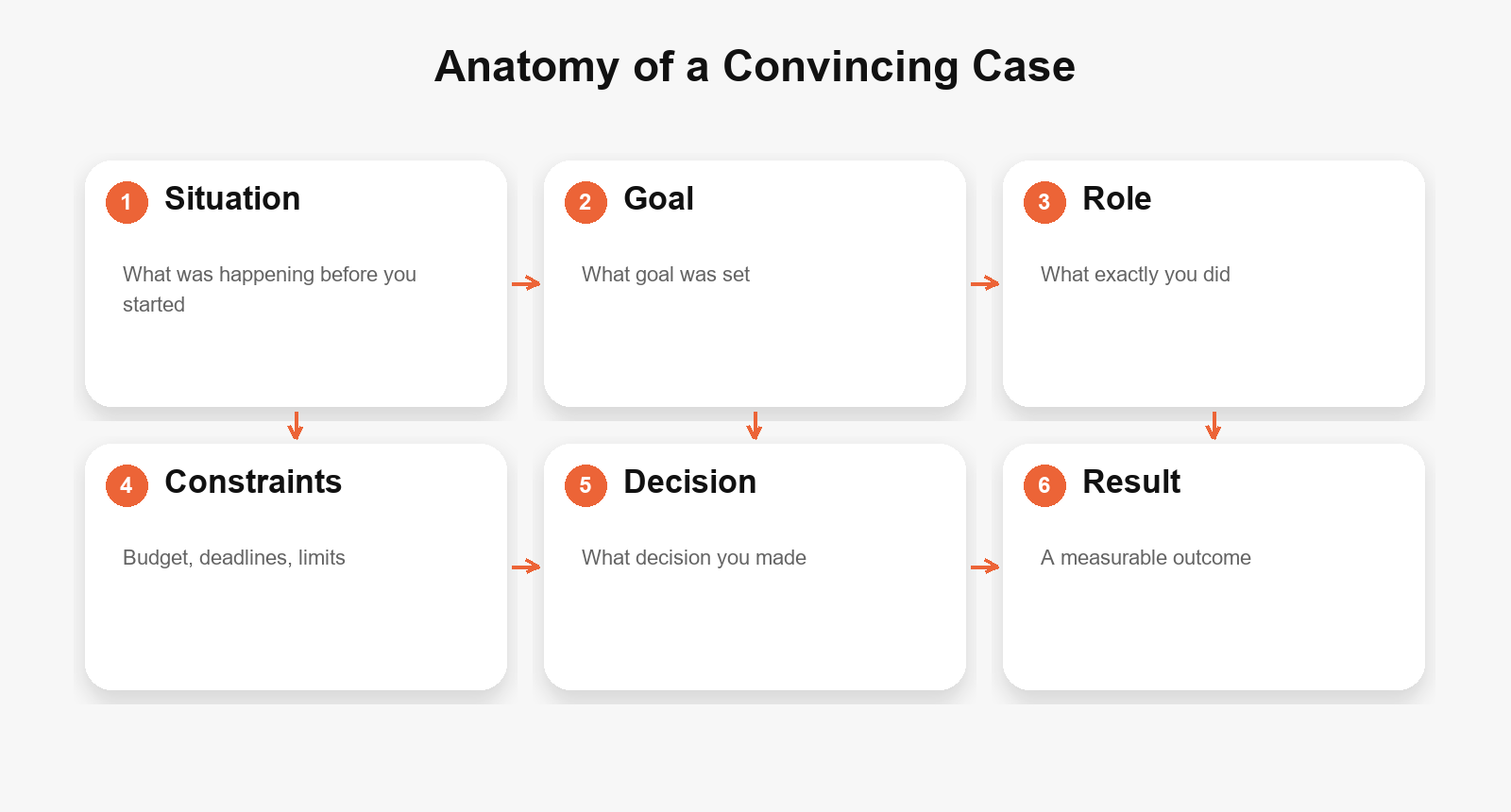
The role and constraints steps are the ones people skip, and they are the ones that separate a real case from a padded one. "I ran a link building campaign" tells a reader nothing about your judgment. "I was the sole strategist on a team of three, working with a fixed content budget, and chose to prioritize two content clusters over five because the traffic ceiling on the other three was too low to justify the spend" tells them exactly how you think. Employers are not hiring a list of tactics. They are hiring the judgment behind the tactics, and judgment only shows up when you name the constraint you were solving for.
What to Show as an SEO Specialist
An SEO case study earns trust through specificity that only comes from having actually done the work: a crawl budget finding, a clustering method, an indexation number, not a generic "improved rankings."
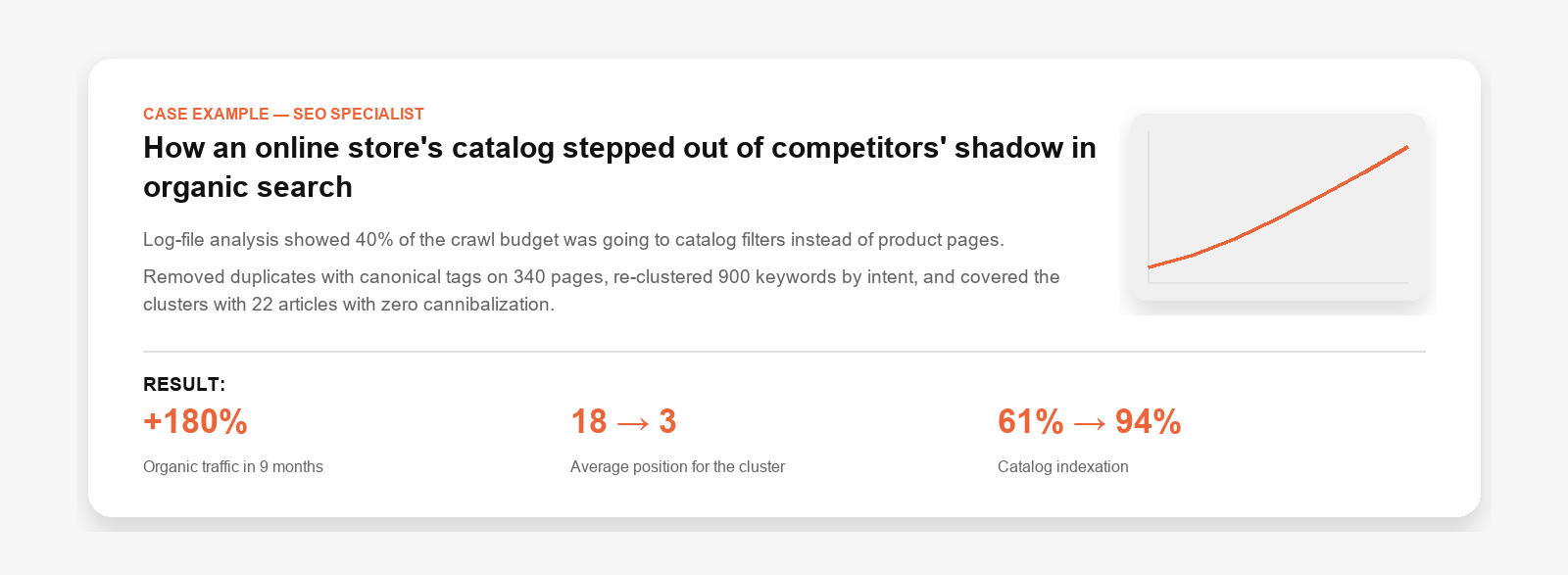
Concretely, an SEO portfolio case should name:
- The diagnosis, not just the fix. What did a log file, a crawl, or Search Console actually show before you touched anything.
- The clustering logic. Whether you grouped keywords by search intent or by volume, and why that choice mattered for this specific site.
- What you shipped and in what order. Canonical fixes, content, internal linking, in the sequence you actually did them.
- A traffic and a position number, not just one. A ranking jump without a traffic number can be a vanity metric; showing both proves the ranking mattered.
Avoid generic bullet points like "performed technical audit" or "improved content strategy." Those phrases appear on almost every SEO resume and prove nothing on their own. Naming the specific finding is what makes the case yours.
What to Show as a PPC Specialist
A PPC case has an advantage over SEO: the numbers are faster to prove and easier to isolate to your own work. Use that.
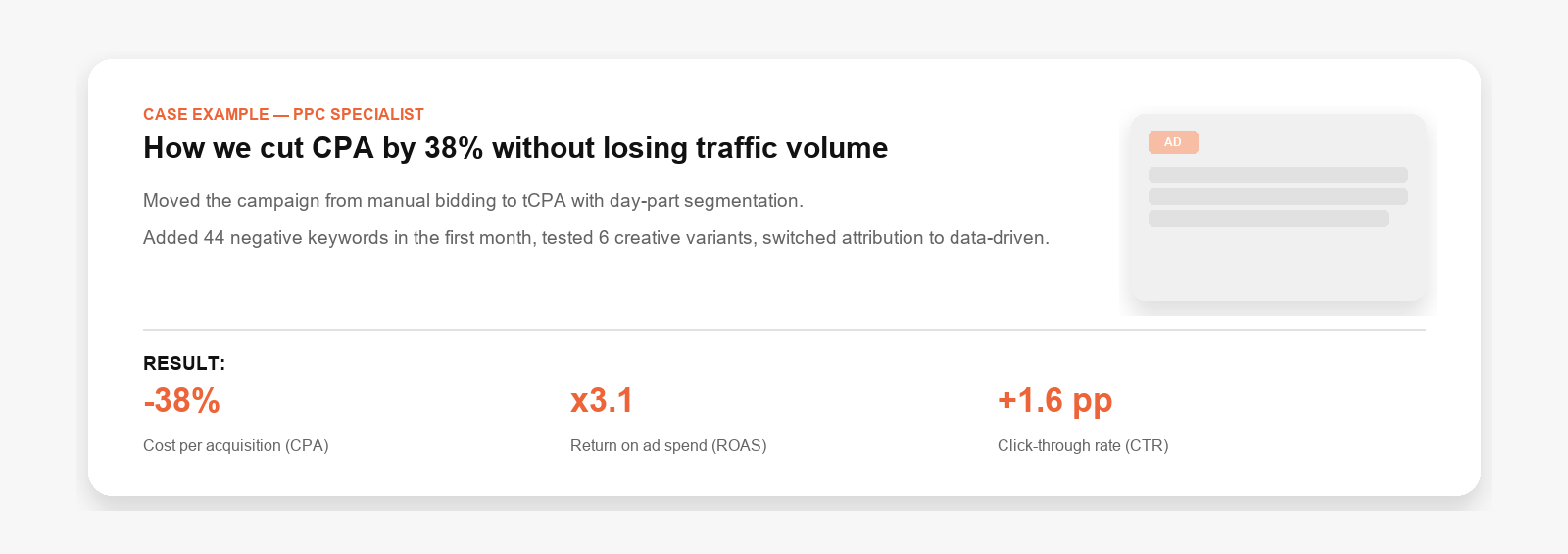
Show, at minimum:
- The bidding strategy change, named specifically (manual to target CPA, last-click to data-driven attribution), not just "optimized bidding."
- The account hygiene work. Negative keyword counts, search term audits, the kind of unglamorous work that actually moves CPA.
- The creative testing process. How many variants, what you were testing for, and what won.
- CPA, ROAS and CTR together, not just the one metric that looks best. A client evaluating you will notice if you only show the flattering number.
If you managed budget, say how much and over what period. Vague statements about "significant improvement" read as a warning sign to anyone who has managed a PPC account themselves.
What to Show as a Digital Marketer Running Multiple Channels
The hardest case to write well is the multi-channel one, because it is tempting to just list the channels you touched. The case that actually lands is the one that shows how the channels were connected, not just which ones existed.
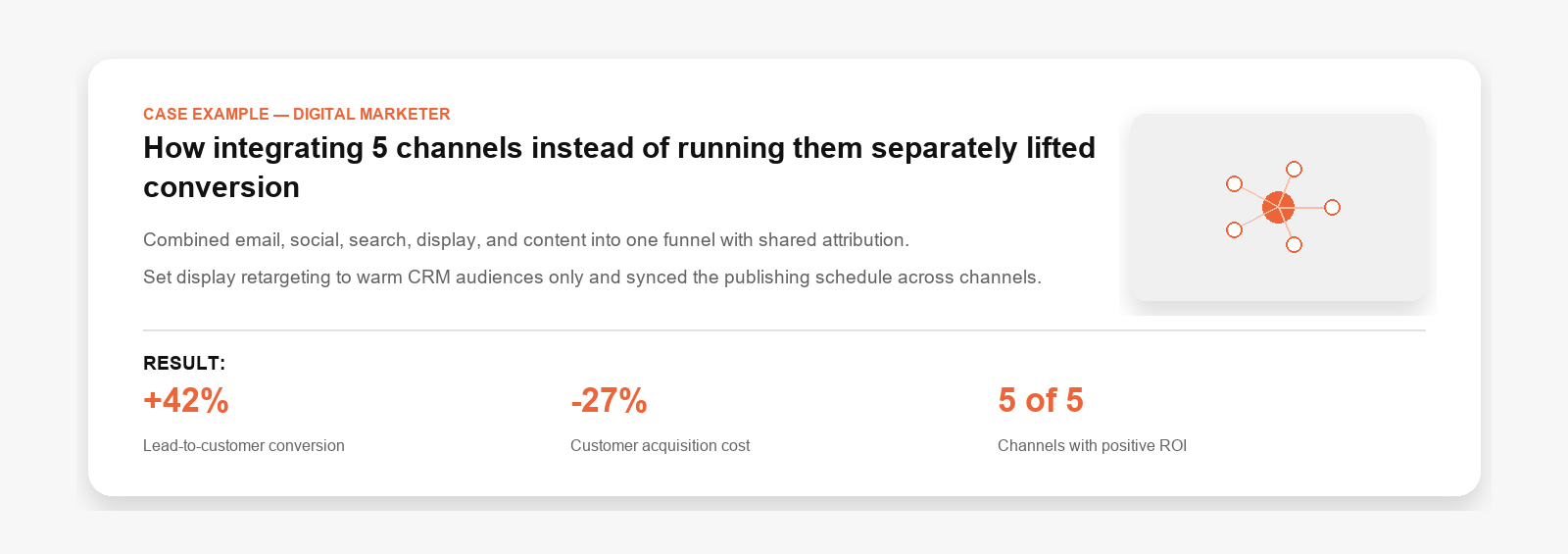
The strongest version of this case shows:
- A single shared goal across channels, and how each channel's role was defined against it, rather than five disconnected campaigns run in parallel.
- The attribution model you used to judge which channel deserved credit, since without this the "which channel worked" question is unanswerable.
- One deliberate sequencing or targeting decision, such as retargeting only warm CRM segments instead of a broad audience, that shows strategic thinking rather than just channel management.
- A business result, not a vanity one. Lead-to-customer conversion or acquisition cost tells a hiring manager more than impressions or reach.
How to Share Numbers Without Breaking an NDA
Most client work comes with confidentiality expectations, written or implied, and a lot of portfolios either break them or overcorrect into vague uselessness. Neither is necessary.
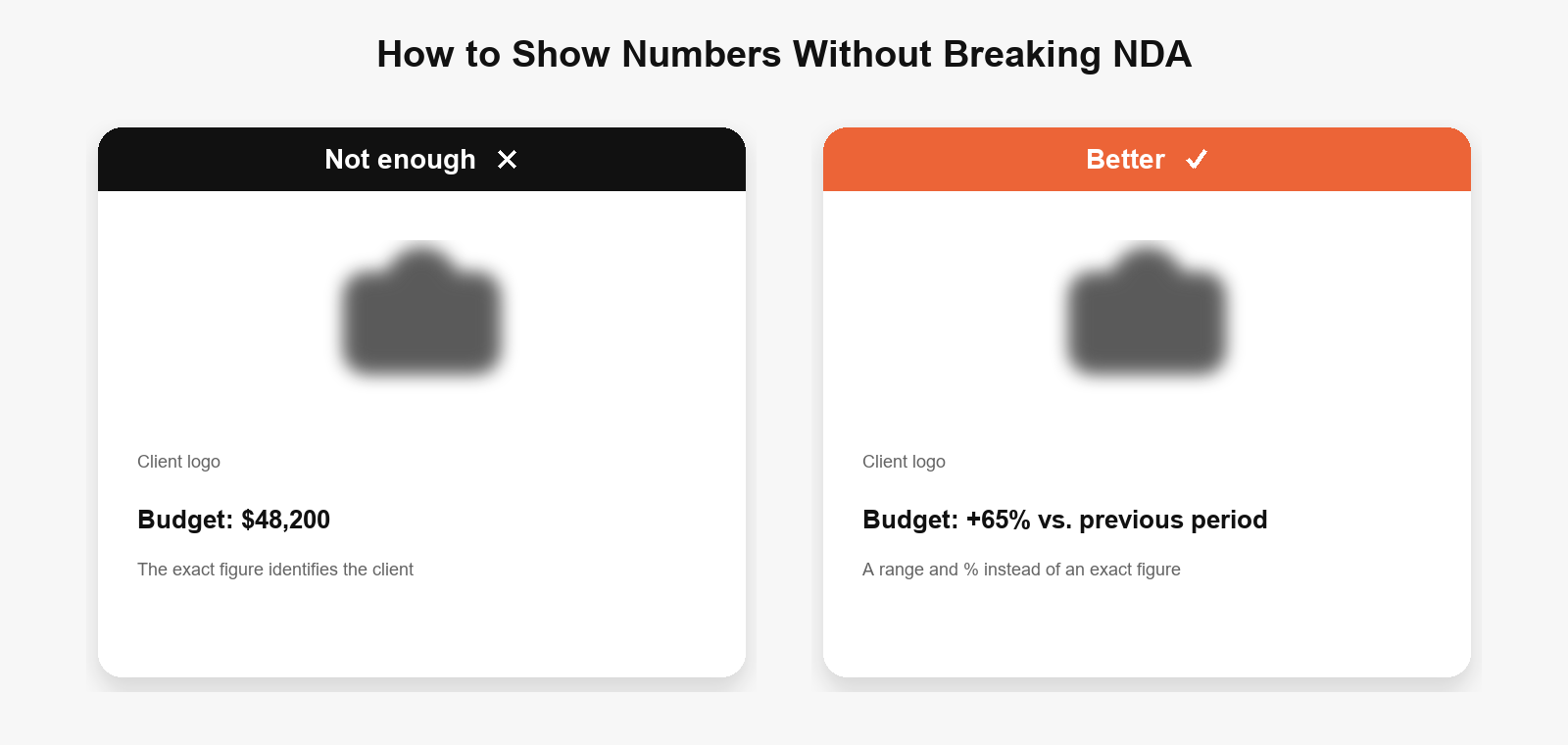
A blurred logo with an exact dollar figure next to it protects nothing, since the number itself, combined with the industry and timeframe, is often enough to identify the client. The safer approach is to keep the client anonymous by industry and size range, and report the result as a relative change or a range instead of an exact figure: "organic traffic up 180% over 9 months" instead of "traffic grew from 4,200 to 11,800 visits." If a prospective client specifically asks for exact numbers during a later conversation, that is a decision to make case by case, ideally with the former client's sign-off, not something to default to on a public page.
No Client Work Yet? Here Is What to Show Instead
If you do not have paid client results, do not leave the portfolio empty and do not fabricate results. Three honest alternatives work:
- A self-directed project, run on your own site or a volunteer nonprofit's, with the same situation-goal-role-result structure and real, verifiable numbers.
- A teardown. Pick a real, public site with an obvious SEO or PPC issue, document what you would change and why, and be specific enough that a reader can tell you actually looked at the account or the code, not just the homepage.
- A documented learning project, clearly labeled as practice rather than paid work, showing the same judgment-under-constraint thinking as a real case.
Label these clearly. A hiring manager will respect an honest "practice project" far more than a real case dressed up to look bigger than it was.
Where to Host It: Website vs PDF vs LinkedIn
A personal site, even a single page, outperforms a PDF or a LinkedIn-only presence for one reason: it is the only format you fully control, and it is the only one Google can index, which means it can generate inbound interest on its own over time. A PDF is fine as something you attach to an email after first contact, and a LinkedIn "Featured" section works as a secondary pointer, but neither should be the only home for your case studies. If you are not ready to build a full site, a single well-structured page is enough to start.
What Strengthens a Case Beyond the Case Itself
Even strong cases carry less weight without three things a reader takes in alongside the text.
- A named testimonial, not an anonymous quote. "Great to work with, highly recommend" proves nothing because nobody can verify who said it. A testimonial with a name, title and company ("Maria Chen, Head of Marketing, Company X") acts as a second, independent confirmation of the case, and one or two sentences about a specific result beat a paragraph of general praise.
- Media mentions or industry coverage, if you have any. Even a single link to an article, interview or conference talk builds trust faster than another paragraph about your skills, because it is third-party confirmation rather than self-description.
- Services framed around the client's own question, not a feature list. Not "I run SEO audits" but "I want to know where I am losing traffic and what to fix first." Language that mirrors the client's own internal question lands faster than a description of your process.
None of these three replace a case with a result, but without them a portfolio reads as self-description rather than independently confirmed expertise.
Mistakes That Undermine an Otherwise Good Portfolio
- Listing skills and tools instead of results, which reads as a checklist rather than proof of judgment.
- Writing in vague theory instead of naming the specific situation, decision and number.
- Showing five thin cases instead of two or three fully developed ones.
- Taking credit for a team's result without naming your specific role.
- Leaving cases outdated for a year or more, which signals the work has gone stale.
- Skipping design entirely. A strong case study loses credibility fast in a cluttered, unreadable layout.
FAQ
What should a digital marketing portfolio include if I have no clients yet? A self-directed project or a documented teardown of a public site, both clearly labeled as practice, built around the same situation-goal-role-result structure as a real case.
How many case studies should a marketing portfolio have? Two to four fully developed cases beat ten thin ones. Depth is what proves judgment, not volume.
Can I show exact client numbers in a public portfolio? Usually not without client sign-off. Use relative changes or ranges, and keep the client anonymous by industry and size instead of blurring a logo next to an exact figure.
Should an SEO, PPC and digital marketing portfolio look different? The structure is the same, but the proof differs: traffic and position data for SEO, CPA/ROAS/CTR for PPC, and a cross-channel attribution result for a multi-channel marketer.
Summary
A digital marketing portfolio earns trust through specificity, not volume: a clear positioning line, client proof, and two or three cases built on situation, goal, your role, constraints, decision and a measurable result. Whether you work in SEO, PPC or across channels, the details that make a case believable are the ones a template cannot fill in for you. If you want help turning results like these into consistent organic visibility rather than a one-off page, see our SEO marketing and content optimization services, or read how we structure AEO-ready content and get pages cited in AI Overviews.