

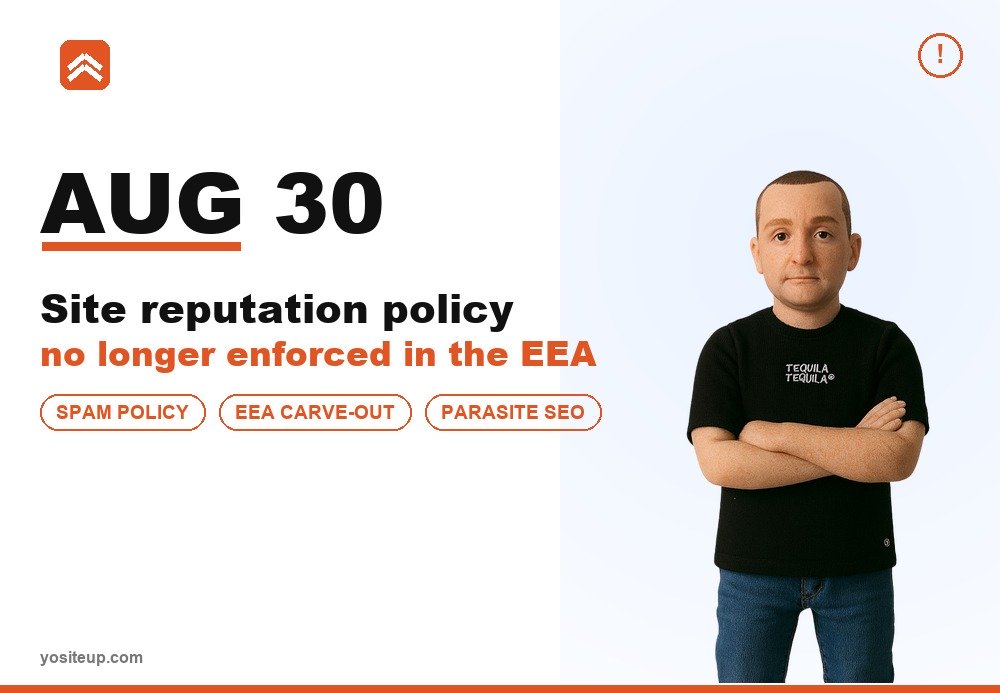
Most US agencies read a headline like "Google eases site reputation abuse penalties in Europe" and file it under regulatory news that does not touch domestic accounts. That read misses one detail: the rule change that took effect on August 30, 2026 is triggered by where a searcher sits, not where a website or its owner is based. A US-registered site with any meaningful traffic from Europe is already living under this new rule for that slice of its audience, whether anyone on the account noticed or not.
The Policy in Plain Terms
Google's site reputation abuse policy targets a specific setup: a low-quality third-party section - typically sponsored casino content, loan comparisons, or coupon aggregators - riding on the authority of a much stronger host domain that has no editorial relationship to it. Google's usual response is a manual action that can demote the entire host domain, not just the offending section. As of August 30, 2026, that full-domain demotion no longer shows up in results served to users physically located in the European Economic Area. It still shows up exactly as before for users outside it.
Why a US Agency Should Actually Read the Fine Print
Many US-based publishers and e-commerce brands run affiliate or sponsored-content sections aimed partly at international traffic, or simply pick up meaningful organic traffic from Europe without targeting it deliberately. If any client site carries a flagged section and also earns real search traffic from EEA countries, that portion of its audience is now seeing a different outcome than the rest of its traffic - a technical separation of the flagged section rather than a full penalty. Reporting that blends geographies together can hide this split entirely, making a partial recovery in Europe look like nothing changed, when in fact something did.
What Changed on the Ground
Google can now technically wall off the flagged section so it ranks independently on its own signals for EEA searchers, instead of dragging the whole domain down for that audience. The section itself typically still loses most of its ranking power, since it can no longer borrow the host domain's authority - so this is not a loophole that makes the underlying tactic safe again. What it does is stop the collateral damage to the rest of the site for that specific slice of its audience. Search Console manual action notices and the reconsideration process are unaffected by any of this.
Why the Regulatory Pressure Behind It Matters More Than the Policy Itself
The European Commission pushed this change through a Digital Markets Act investigation, after publishers argued that legitimate white-label commercial arrangements were getting caught in the same net as outright parasite SEO schemes. Google is not known for volunteering carve-outs to its own spam policies, so a regulator successfully forcing a geography-based split in enforcement is the actual news here. US agencies dealing with state-level privacy law or platform-regulation proposals should expect the same playbook eventually: regulatory pressure producing jurisdiction-specific enforcement rather than a uniform global policy.
A Short Checklist Before the Next Client Report
- Pull organic traffic by country for any client site running sponsored or affiliate sections on a higher-authority domain, and separate EEA countries out from the rest.
- Check Search Console for any existing site reputation abuse manual action before assuming this change is irrelevant to the account.
- If a manual action exists and the site has EEA traffic, expect a partial recovery specifically from that geography, not a full lift everywhere.
- Do not treat this as clearance to relaunch a flagged section - the section itself still ranks weakly on its own once separated.
Frequently Asked Questions
Does this apply to a US-based site with no European office or entity? Yes. The rule is based on where the searcher is located, not where the site or business is registered.
Will this show up as a ranking recovery in tools that report global traffic only? Not clearly. Because the effect is limited to EEA searchers, blended global reporting can mask the change entirely - segment by country to see it.
Does the manual action disappear from Search Console? No, the manual action notice and the reconsideration request process are unchanged.
Is the flagged section safe to keep running as before? No. It still loses most of its ranking power once separated from the host domain - it simply stops dragging the rest of the site down for EEA searchers.
Could a similar carve-out eventually apply outside the EEA? Nothing has been announced, but the pattern of regulatory pressure producing jurisdiction-specific concessions is worth watching for other regions.
Should this change how an agency scopes an international audit? Yes - country-level segmentation for any client with cross-border traffic is now necessary to catch effects like this one.
Bottom Line
The August 30, 2026 change to Google's site reputation abuse policy is easy to skip past if a US agency assumes it only concerns European-based sites. It concerns European-based searchers, which is a different and much broader group. Any client account with real EEA traffic is worth a quick country-segmented check before the next reporting cycle.
Related reading: Google's August 2026 Spam Update - full breakdown.